
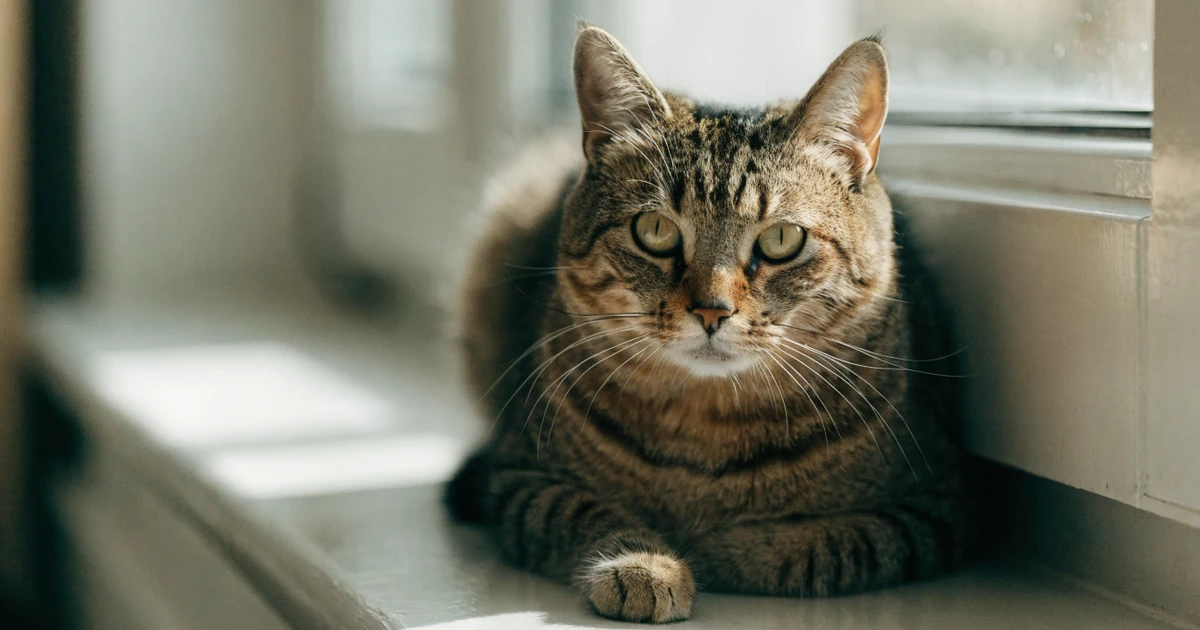
The cat age calculator above will hand you a number in about a second, but start with the cat rather than the maths, because the number only means something once you have noticed the strange shape of a cat's life. The shape is this: the first two years do most of the work. A cat leaves kittenhood and arrives at the human equivalent of twenty-four before its second birthday. Then it slows down and stays slowed for twenty years.
Poppy is asleep on the radiator behind me. Nine years old, eleven pounds, spayed, entirely uninterested in this page. She is 52 in human years, and getting there took her nine years — the same nine years that took her from birth to twenty-four took her, second time round, from twenty-four to fifty-two. That is a front-loaded life, and everything else on this page comes off that one fact.
Cat years to human years: the first two years do the heavy lifting
The conversion is three rules, and they are easier than anything on the dog side:
Year one is worth 15. A twelve-month-old cat sits at the human equivalent of fifteen — physically finished, sexually mature long since, and behaving roughly like a teenager, which anyone who has lived with one will confirm. Year two adds 9, bringing a two-year-old cat to 24. And every year after that adds 4. That is it. Fifteen, twenty-four, then plus four, over and over, out to twenty-five years old and a human equivalent of 116, with no drift and no exceptions anywhere in the chart.
So what are cat years, mechanically? They are a two-speed conversion. The first twenty-four human-equivalent years arrive in twenty-four months; the next ninety-two are spread across twenty-three years. People ask how many cat years is one human year and want a single figure back, but there isn't one, and the gap between the two speeds is enormous — one human year buys a kitten fifteen and buys an eleven-year-old cat four. Nearly a four-fold difference, in the same animal.
The ×7 rule fails here for exactly the reason it fails on dogs, only more obviously. Seven says a one-year-old cat is seven. A seven-year-old human child cannot reproduce, hunt, or live alone. A twelve-month-old cat does all three by lunchtime.
The cat age chart, kitten to 25 years
The cat age calculator above does this lookup for you, but here is the whole table, because a chart you can print and stick inside a cupboard door is worth more than a tool you have to go and find. Kitten months are on it too, which most charts skip.
| Cat age | Human years | Life stage |
|---|---|---|
| 2 months | 2 | Kitten |
| 3 months | 4 | Kitten |
| 4 months | 6 | Kitten |
| 5 months | 8 | Kitten |
| 6 months | 10 | Kitten |
| 7 months | 12 | Junior |
| 12 months | 15 | Junior |
| 18 months | 21 | Junior |
| 2 years | 24 | Junior |
| 3 years | 28 | Adult |
| 4 years | 32 | Adult |
| 5 years | 36 | Adult |
| 6 years | 40 | Adult |
| 7 years | 44 | Mature |
| 8 years | 48 | Mature |
| 9 years | 52 | Mature |
| 10 years | 56 | Mature |
| 11 years | 60 | Senior |
| 12 years | 64 | Senior |
| 13 years | 68 | Senior |
| 14 years | 72 | Senior |
| 15 years | 76 | Super senior |
| 16 years | 80 | Super senior |
| 17 years | 84 | Super senior |
| 18 years | 88 | Super senior |
| 19 years | 92 | Super senior |
| 20 years | 96 | Super senior |
| 21 years | 100 | Super senior |
| 22 years | 104 | Super senior |
| 23 years | 108 | Super senior |
| 24 years | 112 | Super senior |
| 25 years | 116 | Super senior |
Transcribed by Paw Charts from the International Cat Care chart — paw-charts.com
One caution about the top of that table. The kitten rows are visibly rounded — every kitten month is worth exactly two human years, which is a modelling convenience rather than a measurement. Nothing about development is that tidy. Treat the sub-year rows as a rough frame, and if you want real precision under twelve months, weight is a better signal than arithmetic; that is what the kitten growth chart is for.
Why cats age differently from dogs: one curve, not four
Here is the structural difference nobody points out, and it explains why this page is half the length of its sibling.
Dogs range from a four-pound Chihuahua to a two-hundred-pound Mastiff — a fifty-fold spread in body mass inside one species, which is genuinely bizarre in mammals. That spread changes how fast they age, so the dog age calculator needs four separate size columns and still ends up with a twenty-three-year disagreement between a small dog and a giant at the same birthday.
Cats do not do this. A big domestic cat might be eighteen pounds and a small one six. Threefold, at the outside, and most cats cluster far tighter than that. There is no feline equivalent of the Great Dane. So there is one curve for all cats, and that is not a simplification we made for convenience — it is a real feature of the species. Any cat years calculator offering you a breed dropdown for the conversion itself is offering you a control that does nothing.
Which cuts both ways, and I want to be even-handed about it. Cat lifespans do vary by breed, and that variation is real in the lifespan literature. It is just not in the age-conversion chart, because the chart has no breed input to begin with.
The chart is International Cat Care's, not AAFP or AAHA's
Competitors get this wrong constantly, and it is worth correcting because the wrong attribution makes the chart sound more evidence-based than it is.
The 15/24/+4 chart is International Cat Care's. It is not in any AAFP or AAHA feline guideline. I text-searched both editions to be sure: the 2021 AAHA/AAFP Feline Life Stage Guidelines contain zero occurrences of "human year", "human equivalent" or "human age". The 2010 edition has exactly one use of the word "human", and it is about expressing weight change in human terms, not age.
The confusion has a traceable cause, and it is a nice piece of detective work. The 2010 AAFP guidelines say their life stages follow "a convenient lifestage classification developed by the Feline Advisory Bureau" — and the Feline Advisory Bureau is the organisation that later became International Cat Care. Same body, two names. That is why the old AAFP stages line up perfectly with the icatcare chart, and it is why people reasonably but wrongly conclude the chart came from AAFP. It went the other way.
Poppy at nine: what a cat age in human years is actually for
Nine years, one curve, no size class to pick. The chart gives 52 human years and the life stage Mature. That took about as long as reading this sentence.
So what is it for? Not precision — 52 is not a measurement of anything inside Poppy. It is a translation device, and its whole job is to make a number you cannot feel into a number you can. "Nine" doesn't land. "Fifty-two" lands. Fifty-two is the age at which a reasonable person books the appointment they have been putting off, and that is the entire practical value of asking how old is a cat in human years.
The thing I actually do with Poppy's nine is different, though, and it is the life stage, not the 52. Mature is when I started paying attention to her weight trend rather than her weight, because in cats a slow loss is a signal and it is easy to miss on an animal you see every day. Her portions come off the cat calorie calculator — 234 kcal a day for an eleven-pound indoor cat, which is less than most people guess — and the cat food calculator turns that into what actually goes in the bowl.
The six life stages, and what changes at the vet
International Cat Care runs six stages, and the calculator returns the one your cat is in:
Kitten (0–6 months). Everything is happening at once. Vaccines, parasite control, the neuter conversation, and growth you can measure week to week. Junior (7 months–2 years). Physically an adult, socially not. This is where the human equivalent races from 12 to 24, and where owners consistently over-feed because the cat still reads as a kitten.
Adult (3–6 years). The quiet stretch. Annual exams, and the honest goal is a baseline — bloodwork taken while everything is normal, so there is something to compare against later. Dental disease starts here and is the single most under-treated thing I see. Mature (7–10 years). Poppy's stage. Weight trend, water intake, and the first real screening for kidney values and thyroid.
Senior (11–14 years). Twice-yearly exams are worth it now. Kidney disease, hyperthyroidism and high blood pressure are all common, all treatable, and all quiet — a cat will hide every one of them until it can't. Super senior (15+). Arthritis is nearly universal and nearly invisible, because cats don't limp, they just stop jumping onto the counter and everyone calls it good manners.
Worth knowing: the current AAHA/AAFP guidelines use a different, shorter model — kitten, young adult (1–6), mature adult (7–10), senior (over 10), plus end of life at any age. They consolidated six stages into five in 2021, and they were careful to say why. In their words, "although the physiologic basis for six feline life stages remains valid, a five-stage grouping makes clinical protocols easier to implement." The biology didn't change; the paperwork did. Two live models, both defensible, and we show you which is which rather than blending them into a mush.
"Outdoor cats only live two to five years" is a scare statistic, and it isn't real. You have read it on shelter pages, insurance blogs and pet-retail sites. I went looking for its source and there is none — no study, no dataset, no primary citation anywhere. It is uncited every single time it appears.
The best data we have says something more interesting. Kent and colleagues, in PLOS ONE in 2022, examined 3,108 feline necropsies at UC Davis spanning 1989 to 2019. Median age at death: indoor-only 9.43 years. Indoor/outdoor 9.82 years. Outdoor-only 7.25 years. Read the middle number twice — cats with outdoor access did not fare worse than indoor-only cats. They were nominally, slightly, longer-lived.
Now let me argue against my own point, because this evidence is not strong and I would rather you knew that from me. It is a single institution, one region, one thirty-year window during which veterinary medicine changed enormously. It is a necropsy sample from a referral hospital, and the authors say so themselves: the collection "may have selected for a less healthy population with a shorter longevity than might have been found in the general population of owned cats." It is correlation. Outdoor-only cats plausibly differ from indoor cats in a dozen ways besides the door — less-owned, less vetted, brought in later — and no necropsy series can separate "being outdoors" from "being the kind of cat who lives outdoors."
So this is not me telling you to let your cat roam. Outdoor-only is clearly the worst of the three, by more than two years, and cars and coyotes are real. It is me refusing to repeat a number nobody can source in order to win an argument I already agree with. The AAFP's own 2021 guidelines put it better than I can: "the traditional classification of a cat as 'indoor' or 'outdoor' is oversimplified as there may be additional risk factors that warrant consideration." When the scare statistic and the data disagree, we print the data.
Human years to cat years calculator: running the chart backwards
Flip the tool and it works as a human years to cat years calculator: give it a human-equivalent age and it finds the cat age that lands there. Sixty in human years is an eleven-year-old cat. Forty is six. Thirty is a cat somewhere in its third year.
The reason to run human years to cat years is usually planning rather than curiosity. "I want to know when she'll be sixty" is a proxy for "I want to know when to switch to twice-yearly visits," and eleven is a genuinely useful answer to that question. It is also the one direction the ×7 rule gets catastrophically wrong in a way people notice — divide by seven and "sixty" comes out as an eight-and-a-half-year-old cat, which is a full two and a half years early.
The arithmetic backwards is the same three rules in reverse: under 15, divide by 15; between 15 and 24, it is somewhere in the second year; above 24, subtract 24 and divide by 4, then add 2. So 52 human years: 52 − 24 = 28, ÷ 4 = 7, + 2 = 9. Poppy, back where she started.
What this cat age calculator cannot tell you
An honest closing note, and it is the same one I put on the dog side. The International Cat Care chart states no derivation. No study, no cohort, no evidence base — like the AKC's dog chart, it is authoritative by convention rather than because someone measured it. It is internally clean, remarkably consistent across sources, and used by veterinary professionals every day, including me. That is a good reason to use it. It is not the same thing as it being a research finding, and every cat years to human years calculator on the internet is running this one table without saying so.
There is also no feline equivalent of the dog world's epigenetic clock — no cat methylation study has produced a rival formula, so unlike the dog page there is no second opinion to show you. A cat to human years calculator can only ever be as good as the single table underneath it, and any cat year calculator that presents its output as science is overselling a convention. We would rather say so.
What is measured, and what I would actually spend your attention on, is the life stage and what it changes: the exam cadence, the screening, the weight trend. Every formula on this page is listed with its source and the date we last checked it on how we calculate. If your household has both species, the dog age calculator is the messier sibling of this page, and the rest of the dog and cat calculators run on the same engine and the same verified data file.
Frequently Asked Questions
How old is my cat in human years?
Use the International Cat Care chart: the first year of a cat's life counts as 15 human years, the second adds 9 more to reach 24, and every year after that adds 4. So a 5-year-old cat is 36, a 9-year-old is 52, and a 15-year-old is 76. The calculator at the top of this page does the lookup and also returns the life stage, which is the more useful half of the answer. Unlike dogs, cats need no size class — there is one curve for every cat, because cats vary about threefold in body weight where dogs vary roughly fiftyfold. One honest caveat: this chart is a professional convention, not a study output, and the organisation that publishes it states no derivation for the numbers.
How many cat years is one human year?
There is no single answer, and that is the whole point of the chart. In the first year, one human year is worth about 15 cat years. In the second year it is worth 9. From the third year onward it is worth 4, every year, all the way to 25. So the exchange rate starts at nearly four times what it eventually settles at. This front-loading is why the multiply-by-seven rule fails so badly on cats: seven would make a 1-year-old cat the equivalent of a 7-year-old child, when in reality a 12-month-old cat is fully grown, sexually mature and capable of living independently. Fifteen is much closer to the truth.
Do indoor cats live longer than outdoor cats?
Not in the way the popular claim says. The widely repeated figure that outdoor cats live only 2 to 5 years cannot be traced to any primary source, and the best available data contradicts it. Kent and colleagues, in a 2022 PLOS ONE study of 3,108 cat necropsies at UC Davis, found median age at death of 9.43 years for indoor-only cats, 9.82 years for indoor/outdoor cats, and 7.25 years for outdoor-only cats. Cats with outdoor access did not fare worse than indoor-only cats. Outdoor-only cats clearly did worse, by more than two years. But that study is a single referral hospital, it is a necropsy sample, and the authors themselves warn it may represent a less healthy population than cats generally.
At what age is a cat a senior?
It depends which model you are using, and the two current ones disagree by a year. International Cat Care, whose chart this calculator uses, calls a cat Senior from 11 to 14 and Super Senior from 15 onward. The 2021 AAHA/AAFP Feline Life Stage Guidelines use a shorter model and define senior as over 10 years. Either way, the practical change is the same: senior cats benefit from twice-yearly exams rather than annual ones, because kidney disease, hyperthyroidism and high blood pressure are all common at that age, all treatable when caught early, and all easy to miss because cats conceal illness until they cannot.
Why do cats age fast at first and then slow down?
Because the biology is front-loaded. A cat reaches full physical and sexual maturity within roughly a year, which in human terms is a fifteen-year process compressed into twelve months. Once that development is finished there is nothing left to build, so the rate drops to the slow accumulation of ordinary aging, which the chart models as 4 human years per cat year and never changes again. The two-speed shape is what makes any fixed multiplier wrong: a single number cannot describe a curve that is steep at the start and then flat for two decades. It is the same reason the multiply-by-seven rule fails on dogs, and it is more pronounced in cats.
Where does the cat age chart actually come from?
From International Cat Care, the UK charity formerly known as the Feline Advisory Bureau. It is commonly and incorrectly credited to AAFP or AAHA — we checked both the 2021 and the 2010 AAFP/AAHA feline guidelines, and neither contains any human-year conversion at all. The confusion is traceable: the 2010 AAFP guidelines state that their life stages follow a classification developed by the Feline Advisory Bureau, which is the same organisation. So the stages flowed from International Cat Care into AAFP, not the reverse. One thing worth knowing about the chart itself is that no source states a derivation or evidence base for the numbers. It is authoritative by convention, and we would rather tell you that than imply it is research.