
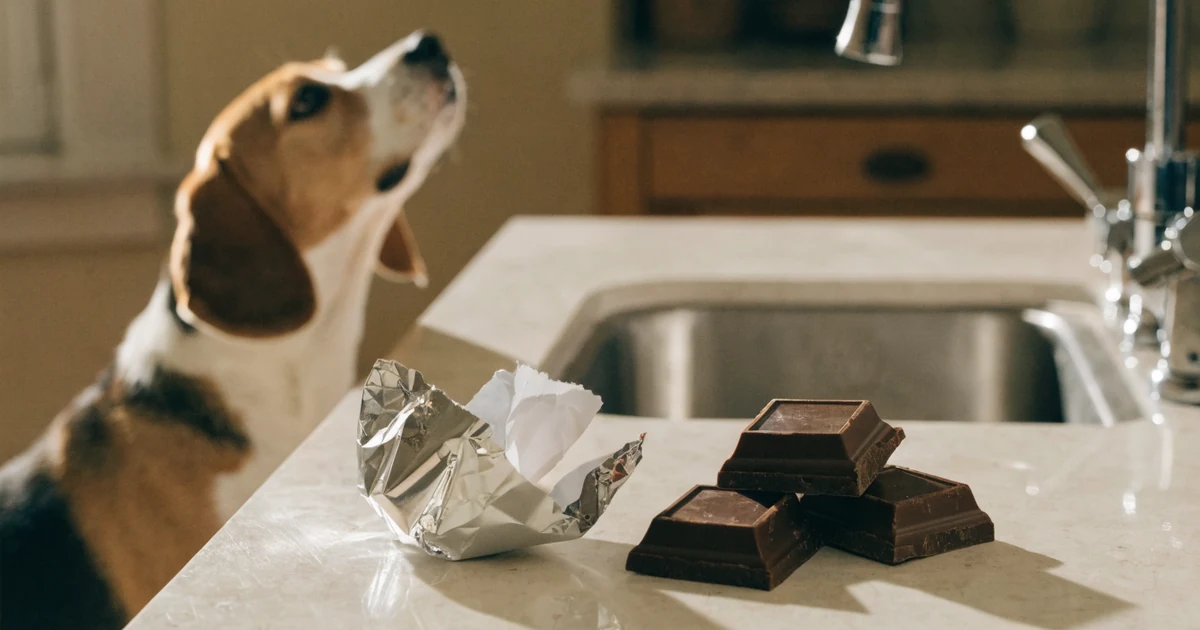
Look at the clock. Whatever time it says, write it down, because that number is worth more than anything else on this page. I spent five years on overnight emergency and the question I asked before any other was never "how much?" — it was "when?" How much they ate decides whether your dog gets sick. When they ate it decides what your vet can still do about it.
I'm Dana Whitcomb, a certified veterinary technician, twelve years in. The tool above will give you a number in about ten seconds. Here is what to do while it's loading.
My dog ate chocolate — what to do right now
Six steps, in this order. You can read the rest of the page afterwards.
- Note the time they ate it. Not the time you found out. Your best guess at the actual moment, and how sure you are of it. Emesis is worth considering for roughly two hours after ingestion, per Merck, so the clock decides whether that door is still open.
- Work out what kind and how much. Weigh the wrapper if you still have it — a kitchen scale and the printed net weight will get you closer than any guess. Count what's left in the box. If you genuinely don't know, assume the worst case: the most chocolate it could have been, of the strongest kind it could have been.
- Run the calculator above. Weight, type, amount. It gives you mg/kg and a triage state.
- Call your vet or a poison control line if the result says call, or if you're unsure of the amount, whatever the number says. A dose built on a guess is a guess. That call is what the guess is for.
- Do not make them vomit at home unless a vet or poison control tells you to and talks you through it. The ASPCA's own wording is that trying to induce vomiting in your pet at home can be dangerous. Call first. This one is not negotiable.
- Take the wrapper with you, or photograph it. Cocoa percentage, net weight, and the ingredients list all matter. Mixed products can also hide macadamia nuts, xylitol, or raisins — any of which can outrank the chocolate as the reason to hurry. A fruit-and-nut bar is two problems in one wrapper.
My dog ate chocolate but is acting fine — what that actually tells you
Almost nothing, yet. That's the honest answer, and I'd rather give it to you than a comfortable one.
Clinical signs of chocolate toxicosis usually appear 6 to 12 hours after ingestion — that's Merck and the ASPCA toxbrief, in agreement. So a dog who ate a bar twenty minutes ago and is currently doing zoomies around the kitchen is behaving exactly as a dog with a serious methylxanthine dose on board would behave. Normal at hour one is not information. It's just early.
Which cuts both ways, and this is the useful part: the decision you make in that quiet first hour is the one that matters most, because it's the only hour in which decontamination is still on the table. Waiting to see whether your dog gets sick spends the window on nothing.
Dog ate chocolate symptoms, and how long before symptoms show
Merck's progression runs roughly like this. Early on: increased thirst, vomiting, diarrhoea, a swollen belly, restlessness. Then it can escalate to hyperactivity, excessive urination, wobbliness, rigidity, tremors and seizures. If your question is "my dog ate chocolate how long before symptoms" — 6 to 12 hours is the window to plan around, with one caveat worth knowing: the ASPCA notes that if the dog ate wrapped candy, effects can be delayed by several hours or days while the foil works through.
Signs can then persist for up to 72 hours in severe cases. That surprises people, and there's a clean reason for it: theobromine's half-life in dogs is about 17.5 hours. Caffeine's is 4.5. A compound that takes seventeen and a half hours to halve doesn't leave overnight, which is why this is a multi-day problem rather than a bad evening.
My dog ate chocolate 24 hours ago
Then the most likely window for methylxanthine signs has already passed, and a dog who is bright, eating and normal at the 24-hour mark is in genuinely better shape than one at hour two. I'll say that plainly because it's true and because the internet rarely will.
Still call. Two reasons. First, "acting normal" is a coarse instrument — tachycardia doesn't announce itself from across the room. Second, pancreatitis is a separate pathway with a separate clock: the ASPCA puts it at 24 to 72 hours after ingestion, driven by the fat and sugar rather than the theobromine. Late presentation changes the conversation. It doesn't end it.
How much chocolate is toxic for a dog?
In plain English, and these are doses of methylxanthines per kilogram of dog:
- Around 20 mg/kg — stomach upset. Merck names the signs specifically: vomiting, diarrhoea, increased thirst.
- 40 to 50 mg/kg — cardiac effects. Note that this is a range. Merck never says a flat 40; every site printing "40 mg/kg" has silently truncated a range it inherited.
- 60 mg/kg and above — seizures. Merck's exact form is "≥ 60," not "at 60." The difference matters when you're standing at a threshold.
- 100 to 200 mg/kg — the reported oral LD50 for both theobromine and caffeine.
Now the part that belongs on a page about how much chocolate is toxic to dogs and almost never appears on one. Those thresholds are the most-repeated numbers in this entire subject, and the ASPCA attributes them, in its own toxbrief, to "(ASPCA/APCC Database: Unpublished data)." Merck reprints them without that attribution. Every calculator downstream then cites Merck. So the chain of custody for the numbers this whole industry runs on terminates in an internal database nobody outside the APCC has seen.
I want to be careful about what I'm claiming. They are the best figures that exist, they're what the profession uses, and I use them here. They are not peer-reviewed fact, and you deserve to know which of those two things you're looking at. Merck's own caveat carries the same warning from the other direction: severe clinical signs and death may occur at much lower doses, and individual susceptibility varies. A low number on this page is a reason to keep watching, never an all-clear.
"How much chocolate will kill a dog" — the honest answer to a badly framed question
People searching for a how much chocolate will kill a dog calculator deserve the number, so: the reported LD50 is 100–200 mg/kg. That's what the tool will show you at the top end.
But "kill" is the wrong frame, and I say that as someone who has worked the overnight shift. Dogs are made very sick by chocolate far more often than they are killed by it, treatment is effective, and the ASPCA's own position is that with appropriate and aggressive treatment most animals make a full recovery. In a study of 156 chocolate ingestions, 112 of the dogs had no clinical signs at all — and the median exposure in that group was 22.4 mg/kg, already past the "mild signs" threshold. In a separate 2017 UK dataset, seizures weren't reported in a single case. The useful question is not "is this lethal." It's "do I need a vet in the next hour" — and that's the question the calculator answers.
Why this dog chocolate toxicity calculator counts caffeine too
Here's the correction I'm proudest of, and it's the reason our numbers will differ from the tool you checked before this one.
Merck's widely-copied milligrams-per-ounce column is headed methylxanthine content. Not theobromine content. Methylxanthines means theobromine plus caffeine, added together. You can verify this yourself in about a minute, because the ASPCA toxbrief splits the two compounds out and the sums land six-for-six on Merck's figures: white 0.25 + 0.85 = 1.1. Milk 58 + 6 = 64. Baker's 393 + 47 = 440. Cocoa powder 737 + 70 = 807. That is not a coincidence. Merck is publishing the APCC dataset as a combined figure.
So any chocolate toxicity calculator dog owners are using that takes Merck's numbers and labels the output "theobromine dose" is double-labelling — it's quietly reporting a methylxanthine total under a theobromine heading. The maths is right and the label is wrong. Go and look at whichever dog chocolate calculator you tried first; if it says "theobromine" and its per-ounce figure for milk chocolate is 64, you've found one.
None of which means the arithmetic is broken, and I want to be fair about that. The published thresholds are themselves methylxanthine thresholds, and the ASPCA's own worked example adds theobromine and caffeine together before dividing by body weight. Totalling both is the correct maths. We just say what we're totalling.
| Type | Theobromine | Caffeine | Total mg/oz |
|---|---|---|---|
| White chocolate | 0.25 | 0.85 | 1.1 |
| Milk chocolate | 58 | 6 | 64 |
| Dark / semisweet chocolate | 130 | 20 | 150 |
| Semi-sweet chocolate chips | 138 | 22 | 160 |
| Baker's / unsweetened | 393 | 47 | 440 |
| Dry cocoa powder | 737 | 70 | 807 |
| Instant cocoa powder | 136 | 15 | 151 |
| Cocoa bean mulch / hulls | 255 | 0 | 255 |
Compiled by Paw Charts from the ASPCA APCC toxbrief and the Merck Veterinary Manual — paw-charts.com
Read the two cocoa powder rows against each other, because that gap is a real trap. Dry baking cocoa is 807 mg/oz. Instant hot-chocolate mix is 151. The same three words on a shopping list, five times the dose. Most calculators collapse them into one "cocoa powder" option and I don't know how they justify it. The mulch row carries an honest asterisk too: the caffeine figure isn't published, so that 255 is a theobromine number sitting in a methylxanthine column, and the real total is probably higher. Cocoa mulch is also wildly variable in the bag. Every one of these figures is a general guideline in Merck's own words, because cocoa beans vary naturally and brands vary on top of that.
Dark chocolate vs milk chocolate for a dog
Owners ask me the dark chocolate vs milk chocolate dog question more than any other, and it has a clean answer. Same weight of chocolate. Different aisle of the shop. Completely different result.
Take a 20 lb dog. If your dog ate milk chocolate — 2 oz of it — that's 128 mg of methylxanthines, which works out at 14.1 mg/kg, and the tool returns Monitor: below the stomach-upset threshold, with a list of what to watch for and when to escalate. Now suppose the same 20 lb dog ate dark chocolate, the same 2 oz. That's 300 mg, or 33.1 mg/kg, and the tool says call your vet. Nothing changed except which bar was on the counter.
Scale it up and it gets starker. A 10 lb dog needs about 1.4 oz of milk chocolate to reach 20 mg/kg, but only 0.6 oz of dark, and just 0.21 oz of baker's chocolate. That last figure is a rounding error of a quantity. It's why the baking cupboard frightens me more than the candy dish, and why "he only had a little bit" is a sentence I've learned to slow down and unpack.
My dog ate chocolate chip cookies
Usually the smallest version of this problem, because a cookie is mostly flour, butter and sugar. The chocolate fraction is small, and a dog that ate one cookie has eaten one cookie's worth of chips — not a cookie's worth of chocolate.
What I won't do is give you a per-chip weight, and I want to explain why rather than just leaving a gap. The figure everyone quotes downstream is "311 chips per cup." It has no traceable origin — I went looking — and it doesn't survive its own arithmetic: one cup is 16 tablespoons, the Toll House label says 14 g per tablespoon, which gives 224 g, while baking convention says a cup of chips is 6 oz, or 170 g. Those can't both be right, and nobody publishing the number seems to have noticed. So: weigh the cookie, or eyeball the chocolate as a fraction of it and enter that. A rough honest input beats a precise invented one.
My dog ate white chocolate
This is the one where the panic and the pharmacology come apart, so it gets the contrarian slot.
White chocolate panic is mostly wasted adrenaline. At 0.25 mg/oz of theobromine, a 10 kg dog would need roughly 11.4 lb of white chocolate to reach even the 20 mg/kg mild-GI threshold. Merck's own footnote calls white chocolate a negligible source of methylxanthines. A 60 lb dog eating 4 oz of it lands at 0.2 mg/kg. That is not a chocolate emergency, and treating it as one costs you sleep you may need later.
But it is not "safe," and this is where I part company with the shrug. VCA, verbatim: "Even if the dose of theobromine is not toxic, dogs can still develop vomiting, diarrhea, or pancreatitis from the fat and sugar in chocolate." Pancreatitis can show up 24 to 72 hours later, long after everyone has relaxed. Foil and wrappers are an obstruction risk in their own right. So the calculator will tell you the methylxanthine dose is trivial and that this is still worth watching — both, because both are true. A tool that says only the first thing is lying by omission.
What your vet will actually do
Descriptive, not a to-do list. None of this is a thing to attempt at home.
If you're inside roughly a two-hour window and your dog is still clinically normal, Merck says induction of emesis should be considered. That's the whole reason step one is the clock. In clinic it's done with licensed veterinary emetics, under supervision, by people who can manage it if it goes wrong. Chocolate can also defeat decontamination on its own terms — the ASPCA notes that large quantities can congeal into a mass in the stomach that won't come back up easily.
Then there's activated charcoal, and here is a live correction worth having. Nearly every chocolate page online still repeats the line about giving repeated doses because methylxanthines undergo enterohepatic recirculation. The mechanism is real and Merck still confirms it. But that's the 2001-era position, and Merck has reversed the clinical guidance: current wording is that the decision should be carefully considered, that hypernatraemia has occurred with charcoal administration particularly with chocolate exposure, and that a single low dose should only be considered with lethal exposures where the benefits outweigh the risks. The evidence that moved it is a 2019 study in the Journal of Veterinary Emergency and Critical Care. If a calculator is still telling you about repeat dosing, you're reading a page that stopped reading its sources a decade ago.
Beyond that: IV fluids to promote diuresis and help clear the methylxanthines, anti-emetics, drugs for tremors or seizures if they appear, and ECG monitoring for arrhythmias. There is no antidote, and no bedside test for chocolate. Diagnosis is your history plus the wrapper — which is step six, and now you know why.
If you want to see every formula, threshold and source behind all of this, with the date we last checked each one, it's on how we calculate. That page is where you can catch us being wrong.
Two things worth doing when this is over
Grapes and raisins are the other food that ends up in my triage room, and they're a genuinely different problem — there, no safe dose is known at all, which is a harder sentence to write than any number on this page. The dog grape toxicity calculator explains why. It's worth ten minutes on a calm day rather than a frightened one.
And once your dog is settled: the rest of this site is arithmetic instead of adrenaline. The puppy weight calculator plots growth on real curves, and the dog age calculator shows what your dog's age actually converts to, with the honest disagreement between the methods laid out rather than averaged away.
Frequently Asked Questions
How much chocolate is toxic to dogs?
It depends on the dog's weight and the kind of chocolate, which is why a calculator beats a rule of thumb. The thresholds are doses of methylxanthines — theobromine plus caffeine — per kilogram of dog: about 20 mg/kg brings stomach upset (vomiting, diarrhoea, increased thirst); 40 to 50 mg/kg brings cardiac effects; 60 mg/kg and above is where seizures are reported. In practical terms, a 20 lb dog reaches the stomach-upset threshold at roughly 2.8 oz of milk chocolate, 1.2 oz of dark, or 0.41 oz of baker's chocolate. Two honest caveats: Merck warns that severe signs and death may occur at much lower doses and individual susceptibility varies, and these thresholds trace back to unpublished ASPCA poison-control case data rather than a peer-reviewed study.
My dog ate chocolate but is acting fine — is that good?
It's expected, and it isn't yet reassuring. Clinical signs of chocolate toxicosis usually start 6 to 12 hours after ingestion, per both Merck and the ASPCA, so a dog who looks completely normal an hour in is behaving exactly as a dog with a real dose on board would behave. Normal at hour one is not information — it's just early. It also cuts the other way, and that's the important part: the first two hours are the window in which your vet can still consider decontamination, so waiting to see whether your dog gets sick spends the most useful hour you have. Run the numbers, then call if you're unsure of the amount. A dog past 24 hours with no signs is in genuinely better shape, but pancreatitis can still appear 24 to 72 hours out.
Dark chocolate vs milk chocolate for a dog — how much worse is dark?
Dark is worse by roughly two and a half times, ounce for ounce. Milk chocolate carries about 64 mg of methylxanthines per ounce; dark and semisweet carry about 150. Worked through on a 20 lb dog: 2 oz of milk chocolate is 128 mg, or 14.1 mg/kg, which our tool returns as monitor-at-home. The same 2 oz of dark chocolate is 300 mg, or 33.1 mg/kg, which is a call-your-vet. Same dog, same weight of chocolate, different answer. And dark isn't the ceiling — baker's or unsweetened chocolate runs 440 mg/oz and dry baking cocoa powder 807, which is why the baking cupboard is more dangerous than the candy dish. White chocolate sits at the other extreme, at 1.1 mg/oz.
Should I make my dog vomit?
Not at home, and not on your own initiative. The ASPCA's position is that trying to induce vomiting in your pet at home can be dangerous, and that even hydrogen peroxide — the only method they describe as usable at home for dogs — needs to be done under the guidance of a veterinary professional, because too much is a problem in itself. Their instruction is that contacting your vet or poison control and explaining the toxin and the amount should always be your first step. Never give hydrogen peroxide to a cat; it's too irritating to their stomach and oesophagus. Timing is the reason to call rather than act: emesis is generally only worth considering within about two hours of ingestion, and your vet has licensed emetics and can manage the risks. Call, then follow what they tell you.
What if I do not know how much they ate?
Assume the worst case and call — that is genuinely the professional standard, not us being dramatic. The ASPCA's own rule for assorted boxes is to calculate as if the whole amount were solid chocolate of the most concentrated form present, and their guidance for mixed products like baked goods is to estimate the dose on a worst-case basis. So enter the largest amount it could have been, of the strongest type it could have been, and treat the result as your floor rather than your answer. Then call your vet or a poison control line and say plainly that you don't know the amount. Guessing low is the most common mistake I see, and it's the one that costs the decontamination window. Bring the wrapper or the box — the packaging is often the only real evidence of quantity.
How long before symptoms show?
Usually 6 to 12 hours after ingestion. That figure comes from both Merck and the ASPCA toxbrief, which agree on it. The earliest signs tend to be increased thirst, vomiting, diarrhoea, a distended abdomen and restlessness; more serious cases can progress to hyperactivity, wobbliness, tremors and seizures. Signs may then persist for up to 72 hours, because theobromine's half-life in dogs is about 17.5 hours — it clears slowly, so this is a multi-day problem rather than one bad evening. Two exceptions worth knowing: if your dog ate wrapped candy, the ASPCA notes effects can be delayed by several hours or days, and pancreatitis from the fat and sugar is a separate risk appearing 24 to 72 hours later, regardless of the theobromine dose.
Will my dog be OK after eating chocolate?
There is no published survival rate for chocolate ingestion in dogs, and any page quoting you a percentage has invented it. What does exist is more useful than a statistic. The ASPCA's position is that with appropriate and aggressive treatment, most animals make a full recovery, and two real-world case series support that: Weingart and colleagues reviewed 156 chocolate ingestions and found 112 of those dogs developed no clinical signs at all, at a median dose of 22.4 mg/kg — which is above the threshold where the textbooks predict stomach upset. A SAVSNET study of UK cases reported no seizures in any case and judged none of the clinical signs life-threatening. So the honest framing is that most dogs who eat chocolate do well, and treated dogs do better still. What I will not tell you is that your dog is fine, because Merck is explicit that severe signs and death may occur at much lower doses and that individual susceptibility varies. Where deaths do happen, Merck attributes them to cardiac arrhythmias, hyperthermia or respiratory failure. Run the dose, then let a vet decide what your dog needs.
How do I flush chocolate out of my dog's system?
You cannot, and that framing is worth correcting because believing otherwise costs people the window that actually matters. There is no antidote for methylxanthines, and Merck notes there is not even a readily accessible diagnostic test for chocolate intoxication. Nothing you can give at home flushes it out — not water, not milk, not bread, not a walk around the block. Theobromine leaves on its own schedule, with a half-life of about 17.5 hours in dogs, which is why signs can run for up to 72 hours. What genuinely removes chocolate is decontamination performed by a vet, and it is time-limited: emesis is generally only worth considering within about two hours of ingestion, and the ASPCA is explicit that trying to induce vomiting at home can be dangerous and that hydrogen peroxide should only be used under veterinary guidance. After emesis, vets give activated charcoal at 1 to 4 g/kg to bind what is left. The practical translation is that the useful action inside the first two hours is a phone call, not a home remedy.
How long should I watch my dog after they eat chocolate?
Plan on 72 hours rather than one evening. Signs usually appear 6 to 12 hours after ingestion, so a normal-looking dog at hour one tells you very little, and both Merck and the ASPCA note signs can persist for up to 72 hours. The reason is pharmacokinetic rather than dramatic: theobromine's half-life in dogs is about 17.5 hours against 4.5 hours for caffeine, so it clears slowly and keeps working while it does. Two things extend the watch beyond the theobromine itself. Pancreatitis, driven by the fat and sugar rather than the methylxanthine dose, can appear 24 to 72 hours later, so a dog who sailed through day one is not automatically clear on day two. And if the chocolate was wrapped, the ASPCA notes effects can be delayed by several hours or even days, because packaging slows everything down and brings its own obstruction risk. What to watch for: restlessness, increased thirst and urination, vomiting, diarrhoea, a distended abdomen, a racing heart, wobbliness or tremors. Any of those, at any point in the 72 hours, is a reason to call rather than to keep watching.