
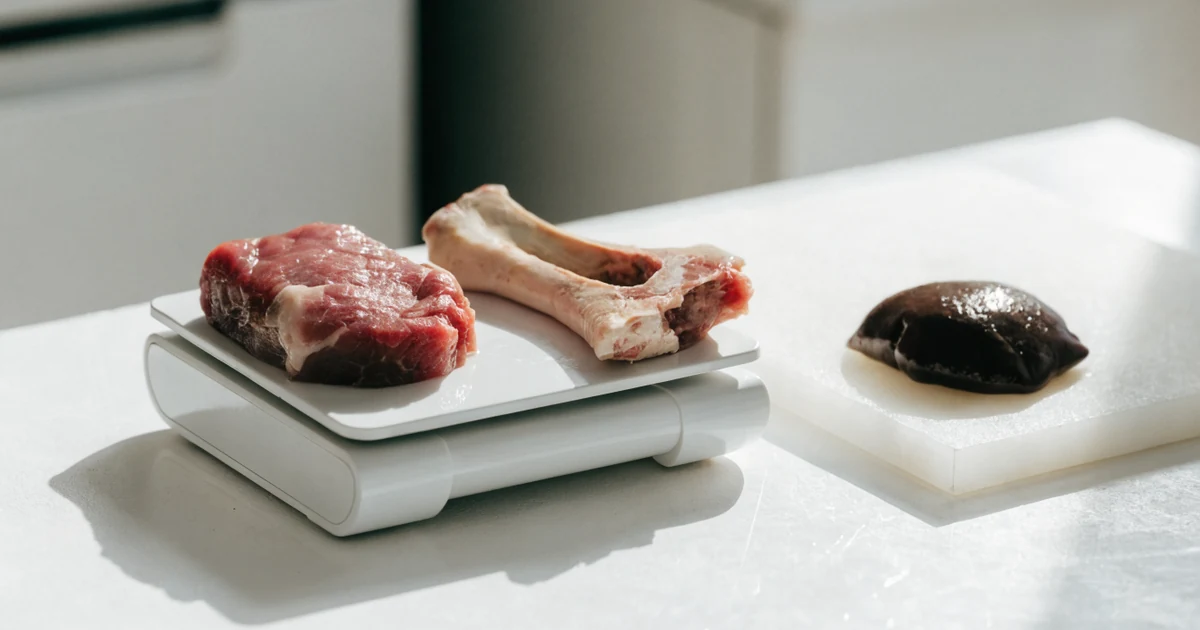
Every raw dog food calculator on the internet hands you the same number — 2.5% of body weight, in grams, split 80/10/10 — and the one above will too. What none of them tell you is where the 2.5% came from. I went looking, because a client asked me once and I answered with more confidence than I had earned, and it bothered me afterwards.
Here's what I found. It's a convention: not a veterinary recommendation, not a study, not a guideline from anybody's nutrition committee — a figure the raw-feeding world settled on and has been handing along for about thirty years. That isn't the same as saying it's wrong. But it's a different kind of number than most people think they're holding.
I'm Dana Whitcomb, a certified veterinary technician twelve years in, and let me be clear about this page's stance before you read on. Raw feeding is contested. I'm going to give you the arithmetic, tell you what it rests on, and put the veterinary objections in front of you without editorial. People who feed raw are not fools and I won't write to you as though you were. What I'll do is be straight about provenance.
Where "2 to 3 percent" actually comes from
It traces to Ian Billinghurst, an Australian veterinarian who published Give Your Dog a Bone in 1993 and coined BARF — Biologically Appropriate Raw Food. Both the BARF camp and the prey-model camp inherited the 2–3% figure from there.
So the honest version has a wrinkle in it, and I'd rather give you the wrinkle than the clean line. Billinghurst is a vet. "No vet ever said this" would be too strong, and I won't say it. What is true is narrower and more useful: no veterinary nutrition body publishes a percentage-of-body-weight feeding rule. We checked, one at a time — Tufts Petfoodology, the American College of Veterinary Nutrition, the WSAVA Global Nutrition Committee, the AVMA, the FDA, the Merck Veterinary Manual, the Pet Nutrition Alliance, UC Davis. Not one states a %BW rule, for raw or for anything else. Every source that does is a raw-feeding site, a raw-food retailer, or a raw-diet calculator.
The 80/10/10 ratio is in the same position — a prey-model derivation reasoned from analogy to a whole prey animal rather than from a nutrient analysis against anybody's published requirements. No veterinary nutrition source endorses it as complete. The tool above labels both on the result itself, not only down here in the copy, because a label you have to scroll to find isn't a label. Both are listed as unsourced conventions on how we calculate, alongside the formulas that do have provenance.
How much raw food to feed a dog
Two to three percent of body weight per day, which is what you came for, and here it is in grams so you don't have to do it in your head at the counter.
| Dog weight | 2% | 2.5% | 3% | Muscle @2.5% | Bone @2.5% | Liver @2.5% |
|---|---|---|---|---|---|---|
| 10 lb | 91 g | 113 g | 136 g | 91 g | 11 g | 5.7 g |
| 20 lb | 181 g | 227 g | 272 g | 181 g | 23 g | 11.3 g |
| 40 lb | 363 g | 454 g | 544 g | 363 g | 45 g | 22.7 g |
| 60 lb | 544 g | 680 g | 816 g | 544 g | 68 g | 34 g |
| 80 lb | 726 g | 907 g | 1089 g | 726 g | 91 g | 45.4 g |
| 100 lb | 907 g | 1134 g | 1361 g | 907 g | 113 g | 56.7 g |
Computed by Paw Charts from the raw-feeding percentage convention — paw-charts.com
Which column you read is conventionally set by what the dog is doing: roughly 1.5% for weight loss, 2 to 2.5% for maintenance, 3% for a genuinely active or working dog. Every one of those is raw-feeding convention rather than published guidance — and the community itself ultimately falls back on the same instruction a vet would give you anyway. Start somewhere sensible, then adjust over two to four weeks on body condition. Ribs, waist, tuck, assessed with your hands rather than a spreadsheet. If you feed kibble alongside raw, the dog food calculator handles that side from your own bag's numbers.
The maths this raw dog food calculator runs that no other one does
A dog's energy requirement does not scale with its body weight. It scales with body weight to the power of 0.75 — that's the resting energy formula in the Merck Veterinary Manual, RER = 70 × (kg)0.75, and it underlies every portion recommendation your vet has ever given you.
The percentage rule is a straight line. The energy requirement is a curve. A straight line can cross a curve but cannot follow it, so one percentage figure cannot be right at both ends of the size range. Not "is inaccurate." Cannot be.
Here's what that costs, run through our own engine at 1,800 kcal per kg of food — the default in the tool above — for a neutered adult dog at 2.5%.
| Dog | Rule delivers | Energy maths needs | Error |
|---|---|---|---|
| 5 kg | 225 kcal | 374 kcal | −40% |
| 10 kg | 450 kcal | 630 kcal | −29% |
| 20 kg | 900 kcal | 1,059 kcal | −15% |
| 40 kg | 1,800 kcal | 1,781 kcal | +1% |
Computed by Paw Charts — paw-charts.com
Look at that table again. Same rule, same food, same 2.5% — and the error walks from 40% under to 1% over with nothing changing but the size of the dog. That's a 41-point swing driven purely by body mass. The rule is close to right for a 40 kg dog and badly under for a 5 kg one, which is exactly the signature you'd predict from putting a straight line against a 0.75-power curve. It isn't a flaw in the rule. It's what the rule is.
There's a second failure, independent of the first. The percentage rule is a mass rule, applied to foods running from roughly 30 to 80 kcal an ounce. Feed the identical "correct" portion of two different raw products and you deliver wildly different energy. A rule expressed in grams cannot be right for two foods at once, and nobody's supplier makes the same mince as anybody else's.
Our tool shows this cross-check live, next to the grams, every time. As far as I can find, no other raw calculator does. That's the argument for using ours — not that our percentage is better, but that we tell you what the percentage is doing. For the energy side on its own, the dog calorie calculator shows the whole derivation.
BARF diet ratios 80 10 10 — what actually goes in each bucket
Eighty percent muscle meat, ten percent raw edible bone, ten percent organ — and that last ten splits again, into 5% liver and 5% other secreting organ. The second half is where people go wrong, and the error is nearly always the same: heart and gizzard are conventionally counted as muscle rather than organ, and lung and trachea aren't secreting organs at all. The other 5% means kidney, spleen, pancreas, brain.
Worked through, so you can see it land. A 25 kg dog at 2.5% eats 625 g a day: that's 500 g of muscle meat, 62.5 g of raw edible bone, 31.25 g of liver and 31.25 g of other secreting organ. Split across two meals if that's how you feed. The tool does it for any weight and any percentage you give it.
Puppy raw percentages, and their complete absence of provenance
The chart everyone publishes runs from 8–10% of body weight at eight weeks, tapering to about 2.5–3% by twelve months. I want to flag it plainly, because growth is where a nutritional error does permanent skeletal damage rather than a reversible one.
Those puppy percentages are sourced only to raw-food retailers. Not thinly sourced — not sourced at all, to any veterinary body, nutrition committee or peer-reviewed paper. Every source I could find sells raw food or blogs about it. The versions don't even agree with each other; the brackets overlap and contradict across sites, which is what a folk consensus looks like when you line it up.
The veterinary equivalent exists and is energy-based rather than mass-based: Merck puts a puppy under four months at 3 × RER and a puppy over four months at 2 × RER. Same reality — puppies need proportionally far more, tapering steeply — on a defensible basis. If you're feeding a growing dog, run both and take the disagreement seriously. Our dog calorie calculator has those multipliers built in, and if you're still working out how big this puppy will be, the puppy weight calculator is the other half of that question.
Homemade dog food calculator: what happens when you cook it instead
People often arrive at raw via homemade, or leave raw for it, so this belongs on the same page. If you're after a homemade dog food calculator, see the evidence on home-prepared recipes first, because it isn't ambiguous and it isn't close.
Stockman and colleagues, in JAVMA in 2013, evaluated 200 recipes for home-prepared maintenance diets for dogs. A hundred and twenty-nine were written by veterinarians. 190 of the 200 — 95% — had at least one essential nutrient below NRC or AAFCO minimums, and 167, which is 83.5%, had multiple. Only five met all essential nutrients: three against the NRC's recommended allowance and two more against the lower minimum requirement, a distinction the web routinely garbles into "5 met NRC." The commonest gaps were zinc in 69% of recipes, choline in 64.5%, copper in 54%, EPA plus DHA in 53.5%.
Cats are worse, and it's worth knowing why. Wilson and colleagues ran the same exercise on 114 home-prepared cat recipes in 2019. Zero met all of the NRC's recommended allowances. Their conclusion, exactly: "Problems with nutritional adequacy were identified in all evaluated HPMD recipes." Cats have more obligate requirements — taurine, arginine, arachidonic acid, vitamin A they can't make from beta-carotene — so there's simply more to get wrong.
The finding that makes the referral argument, and it isn't an appeal to authority
Here's the part I'd underline. The dividing line in Stockman's data is not "a vet wrote it." Vets wrote nearly two thirds of the sample and most of those recipes still had at least one deficiency. Being a veterinarian wasn't enough.
But the paper had four recipes available that were written by board-certified veterinary nutritionists, and all four passed. Four is a small number and I won't oversell it. What I'll say is that it's the study's own conclusion — the authors recommend home-prepared recipes be obtained from or evaluated by board-certified veterinary nutritionists — and it beats "ask a professional," because it comes from the people who measured the failure rate and it names the specific credential that survived it.
The route, concretely: the ACVN maintains the US directory of board-certified veterinary nutritionists, and the ECVCN is the European equivalent. If you'd rather have a formulation than a consult, BalanceIT and PetDiets are both nutritionist-run services that will build you one.
Raw dog food recipes off the internet
Search raw dog food recipes and you'll get thousands, and I'd rather be useful than sniffy about it. Recipes off the internet are precisely the population Stockman sampled — 67 of those 200 came from 23 websites — and 95% of the total were short of something. That's not a reason to sneer at anybody. It's a reason to get a formulation rather than a recipe.
The practical difference: a recipe tells you what to buy. A formulation tells you what the resulting bowl contains, what it's missing, and how to fix the gap. Not the same product, and only one of them has ever been checked.
What vets actually worry about
Fairly, and in their own words, because you should read the position rather than my summary of it. The WSAVA Global Nutrition Committee "recommends that RMBD not be fed to dogs and cats" — raw meat-based diets, as a class. The AVMA "discourages feeding any raw or undercooked animal-sourced proteins" to dogs and cats. Those are the two lines, verbatim, and there's no softer reading available.
The evidence is largely microbiological. In a two-year FDA study, of 196 raw pet food samples, 15 were positive for Salmonella and 32 were positive for Listeria monocytogenes.
And here's the part that gets lost, which is the part I'd want a client to hear: much of the concern isn't about your dog. It's about your household. Pathogens shed in the stool of an animal that looks perfectly well, and the people who get sick are disproportionately the young, the elderly, the pregnant and the immunocompromised — plus whoever handled the mince. If there's a toddler or someone on chemo in the house, that changes the calculation in a way that has nothing to do with how the dog is doing.
Handling it safely, which is not optional
Short and practical, from FDA and CDC guidance. Keep raw food separate from your own — separate cutting boards and utensils, no shared surfaces. Wash your hands with soap and water after handling it and after touching anything it touched. Clean the bowl after every meal rather than topping it up. Thaw in the refrigerator, not on the counter and not in the sink. That's most of the risk reduction available to you, and it's cheap.
So where does that leave the number
With you, which is where it started. The tool gives you the grams and the split, tells you what the energy maths says instead, and labels the convention as a convention. That's the most honest version of this calculator I know how to build.
If you'd rather work from energy than a percentage, the dog food calculator turns a daily calorie figure into portions of your actual food, and the dog age calculator is worth a look if you're adjusting a diet for a dog who has quietly become a senior. Every formula here, with its source and the date we last checked it, is on how we calculate — including, explicitly, the ones with no veterinary source at all. If a number on this page is wrong, that's where you'll catch us.
Frequently Asked Questions
How much raw food should I feed my dog per day?
The raw-feeding convention is 2 to 3 percent of body weight per day: roughly 1.5% for weight loss, 2 to 2.5% for maintenance, 3% for an active or working dog. In grams, a 20 lb dog at 2.5% eats about 227 g a day, a 60 lb dog about 680 g, a 100 lb dog about 1,134 g. Two caveats. That percentage is a raw-feeding convention, not veterinary guidance — no veterinary nutrition body publishes a percentage-of-body-weight rule. And energy needs scale to body weight to the power of 0.75 while the rule is linear, so at 1,800 kcal per kg of food, 2.5% underfeeds a 5 kg dog by about 40% while landing within 1% for a 40 kg dog. Treat it as a starting point and adjust on body condition over two to four weeks.
Where does the 2 to 3 percent raw feeding rule come from?
It traces to Dr. Ian Billinghurst, an Australian veterinarian who published Give Your Dog a Bone in 1993 and coined BARF — Biologically Appropriate Raw Food. Both the BARF and prey-model camps inherited the figure from there. Billinghurst is a veterinarian, so saying no vet ever proposed it would be too strong. The accurate claim is narrower: no veterinary nutrition body publishes a percentage-of-body-weight feeding rule. We checked Tufts Petfoodology, the ACVN, the WSAVA Global Nutrition Committee, the AVMA, the FDA, the Merck Veterinary Manual, the Pet Nutrition Alliance and UC Davis. Every source that does state the rule is a raw-feeding site, a raw-food retailer, or a raw-diet calculator.
What is the 80/10/10 ratio in a BARF diet?
80% muscle meat, 10% raw edible bone, and 10% organ — with that last 10% splitting into 5% liver and 5% other secreting organ, meaning kidney, spleen, pancreas or brain. The common mistakes are consistent: heart and gizzard are conventionally counted as muscle rather than organ, and lung and trachea are not secreting organs. Worked through, a 25 kg dog at 2.5% eats 625 g a day: 500 g muscle, 62.5 g bone, 31.25 g liver and 31.25 g other secreting organ. The ratio is a prey-model derivation, reasoned by analogy to a whole prey animal rather than from a nutrient analysis. No veterinary nutrition source endorses it as complete.
Can I use a calculator to make homemade dog food?
Read the evidence on home-prepared recipes first, because it is stark. Stockman and colleagues evaluated 200 home-prepared dog recipes in JAVMA in 2013: 190 of them, 95%, had at least one essential nutrient below NRC or AAFCO minimums, and 83.5% had multiple deficiencies. Only 5 met all essential nutrients. Zinc was short in 69% of recipes, choline in 64.5%, copper in 54%. A parallel 2019 study of 114 home-prepared cat recipes found none met all NRC recommended allowances. The useful detail: 129 of the dog recipes were written by veterinarians and most still had a deficiency, but all four written by board-certified veterinary nutritionists passed. That is the case for a formulation rather than a recipe.
Why do veterinarians advise against raw feeding?
Their objections are specific rather than vague. The WSAVA Global Nutrition Committee recommends that raw meat-based diets not be fed to dogs and cats; the AVMA discourages feeding any raw or undercooked animal-sourced proteins. The evidence is largely microbiological: in a two-year FDA study, 15 of 196 raw pet food samples were positive for Salmonella and 32 for Listeria monocytogenes. Much of the concern is human rather than canine — an apparently healthy dog can shed pathogens in its stool, and those most at risk are children, the elderly, pregnant women and anyone immunocompromised in the household, plus whoever handles the food. It is a household decision, not only a dog one.
How much raw food does a puppy need?
The chart everyone publishes runs from 8 to 10% of body weight a day at eight weeks, tapering to about 2.5 to 3% by twelve months. Said plainly: those puppy figures are sourced only to raw-food retailers. No veterinary body, nutrition committee or peer-reviewed paper states them, and the versions across sites overlap and contradict each other. The veterinary equivalent is energy-based rather than mass-based — the Merck Veterinary Manual puts a puppy under 4 months at 3 times its resting energy requirement and a puppy over 4 months at 2 times. Growth is where a nutritional error does permanent skeletal damage rather than a reversible one, so it is the worst place to run an unsourced rule.