
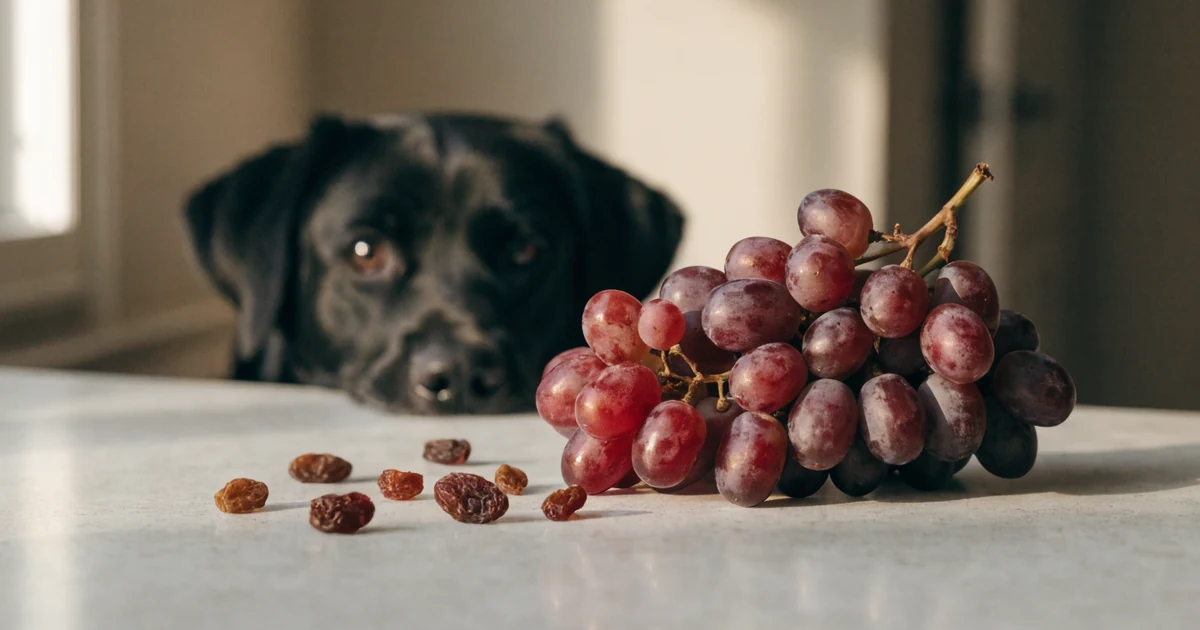
I'm Dana Whitcomb, a certified veterinary technician, twelve years in and five of those on overnight emergency. This is the page I found hardest to write on this whole site, because the useful thing I have to tell you is a thing I don't know. Steps first. Then I'll explain why the not-knowing is the honest answer rather than a dodge.
My dog ate grapes — what to do right now
Six steps. Notice that the call comes first here, which is not how the chocolate page is built — there, the dose decides. Here it can't.
- Call your vet or a poison control line now. Not after you've read this page. There's no count low enough for me to tell you to skip this, and that's the whole finding rather than an abundance of caution.
- Note the time, and what it actually was. Grapes, raisins, sultanas, Zante currants — all dried grapes count. So does anything baked around them: fruitcake, mince pies, hot cross buns, trail mix, cereal.
- Work out roughly how many. Count what's gone from the punnet or the box. Enter it above so you have grams and g/kg ready to say out loud on the phone.
- Don't try to make them vomit at home. Call before you do anything of the kind — the timing, the method and whether it's safe for your dog at all are exactly what that call decides, and a dog who is already vomiting or unsteady is one you can genuinely hurt this way.
- Don't wait to see if they get sick. Kidney injury shows up in bloodwork before it shows up in your dog. By the time you can see it, you've lost the part of the timeline that treatment is good at.
- Take the box or the packet. Weight and count on the packaging beat anyone's memory at 2am.
Nobody knows the toxic dose. That is the actual state of the science
I want to be exact about what is and isn't established, because the gap between the two is the whole reason this dog grape toxicity calculator will not draw you a safe line.
Established: grapes and raisins cause acute kidney injury and death in dogs. That's been in the literature since 2001 and it is not in doubt. Since 2021 the evidence points strongly — though not conclusively — at tartaric acid as the poison.
Not established: any dose below which they're safe. Not a threshold, not a dose–response curve, not a reason why one dog is fine and the next one isn't. Four things compound to make that so, and each is sourced:
- The poison isn't evenly distributed. Tartaric acid in grapes runs roughly 0.35% to 1.1% and can reach 2%, varying with cultivar, growing conditions and locality. Two identical-looking grapes are not the same dose. Merck says it plainly: the tartaric acid content varies, resulting in variable effects following ingestion.
- Dogs differ. VCA, verbatim: "there is no well-established toxic dose for any of these fruits and some dogs may have individual sensitivities."
- The clinical data show no dose–response. Savigny and Macintire, 2007: "the dose ingested was not related to the severity of clinical signs or outcome."
- The poison services say so outright. The UK VPIS: "This variation in tartaric acid concentrations emphasises the lack of toxic dose."
And then there's the fact that ends the argument, which I think about more than I'd like. A border collie survived eating a 16 oz box of raisins. A Labrador died after a 20 oz box. Both got peritoneal dialysis. Same fruit, four ounces apart, opposite outcomes. That's Savigny and Macintire again, and if you can build a "how many is too many" rule that accommodates those two dogs, you're a better statistician than anyone who has tried.
My dog ate grapes but seems fine
Seeming fine is what I would expect right now, and it is not yet information.
Vomiting is usually the first sign and it typically starts 6 to 12 hours after ingestion — that's Merck. I'll flag the disagreement rather than average it away: Wegenast's 2022 case series and VCA both put the window at 12 to 24 hours, and there are documented cases of vomiting inside two. The spread itself tells you something, which is that early appearance is unreliable in both directions.
The real reason "seems fine" doesn't help is what's happening underneath. Kidney injury declares itself on bloodwork before it declares itself in behaviour, and azotemia typically appears somewhere in the 24 to 72 hour window after exposure. A dog can be bright, eating, wagging, and already have creatinine on the move. Normal bloodwork in the first 12 hours doesn't clear them either. That's the single most important clinical nuance here, and it's why the answer to "my dog ate raisins but seems fine" is the same as the answer to "my dog ate raisins and is vomiting": call, today, now.
There is a genuine all-clear point, and it's worth knowing about: Savigny and Macintire found that if a dog hasn't developed azotemia within 72 hours of eating grapes or raisins, clinical problems are likely to be avoided. That's three days of knowing, not three hours.
My dog ate raisins 24 hours ago
Call anyway, and don't let anyone tell you it's pointless. You're inside the window in which kidney values change, which means bloodwork now is diagnostic rather than academic, and IV fluid diuresis still has work to do. "It's been too long" is the belief I'd most like to remove from this topic.
The numbers we do have, and exactly what each one is
Three figures circulate. They are not interchangeable, and most of the confusion in this subject comes from people treating them as if they were.
Merck's risk threshold: more than 1 grape or raisin per 4.5 kg (10 lb) of body weight. This is a conservative figure derived from how much tartaric acid a grape could contain, not an observation of sick dogs. It's deliberately cautious, and for a consumer tool that's the right property to have, so it's what this dog raisin toxicity calculator flags against.
The "lowest observed toxic doses": 0.7 oz/kg for grapes, 0.11 oz/kg for raisins. Read the label carefully, because it's doing all the work. These are the smallest amounts recorded in dogs that got sick. They are not thresholds. Nothing about them says a dog below them is fine — they're just the bottom of a scatter of case reports.
Now put the two side by side for a 10 kg dog. Merck flags above 2 grapes. The lowest observed dose works out at roughly 40 grapes. That's a twentyfold gap, and it is not a contradiction — they're answers to different questions. One asks "when should we worry," the other asks "what did sick dogs happen to have eaten." The honest reading of a 20× gap is that the true threshold sits somewhere unknown inside it, and neither number is it.
A citation correction, on a page about source honesty
Those 0.7 and 0.11 figures are attributed all over the internet — and by several competitor calculators — to Eubig et al. 2005. I went to check that attribution and could not verify it. The Eubig abstract contains no dose figures at all. The earliest source I could confirm actually carrying those numbers is Savigny and Macintire 2007, which lists Eubig only under "Recommended Reading" rather than as an inline citation for the figures.
They may well be in Eubig's full text; it's paywalled and I couldn't get it. But I'm not going to repeat a citation I haven't verified on the one page whose entire argument is that this field repeats things without checking them. So we cite Savigny and Macintire. If someone sends me the Eubig full text and the numbers are in there, I'll happily change it and say so on how we calculate.
Are raisins worse than grapes for dogs?
Yes, per gram — and the nice part is that two independent routes agree on roughly how much worse.
The clinical figures say raisins' lowest-observed dose is 6.4× lower than the grape one. Separately, the plain physics of drying predicts about 4.3×: USDA composition data puts grapes at 19.5 g of dry matter per 100 g against raisins' 84.5 g, and 84.5 ÷ 19.5 is 4.3. Take the water out, and everything left behind — including the tartaric acid — concentrates by that factor. Potassium, the counter-ion of potassium bitartrate, moves 3.9×. Same direction, same order of magnitude.
Two numbers derived from completely different evidence landing within spitting distance of each other is a genuine cross-check, and it's the strongest support I know of for the concentration story being the right one. It's also why raisins are worse in practice for a duller reason: they're small, they come loose in cookies and trail mix, and a dog can put away a serious mass of them quickly without it looking like much.
My dog ate 2 grapes, or my dog ate 3 raisins
These get asked constantly, so let me answer without theatre. It depends entirely on the size of the dog, and the answer is never a green light.
For a 10 lb dog, Merck's threshold is one grape. So if your dog ate 2 grapes, you're already past the line the reference literature draws — for a small dog, a single grape is a vet call. For a 20 lb dog the threshold is about two raisins, so 3 raisins is past it too. For a 60 lb Labrador the threshold sits around six of either, and 2 grapes or 3 raisins falls under it.
And under it still isn't clear. Everything above applies: the grape that dog ate might carry three times the tartaric acid of the one next to it in the bunch, that dog might be one of the sensitive ones, and the case literature contains no reliable relationship between amount eaten and outcome. Under Merck's line means less urgent. It does not mean fine, and I won't write it as if it does.
Every calculator that hands you a confident risk tier here has invented one. This is the rare subject where "we don't know" is not a hedge, not a lawyer talking, and not me being careful — it's the finding. The dose–response relationship that a risk tier requires has been looked for and has not been found. You cannot build a green band on top of an absence.
So this tool does something narrower and, I'd argue, more useful: it tells you where your dog sits relative to the two published figures and what each of those figures actually is. Dose informs urgency. It never informs clearance. If another site's grape calculator has ever returned you a reassuring colour, ask what evidence it used, because I've read the literature and it isn't in there.
Tartaric acid: the leading theory, not a settled fact
Worth knowing how strong this evidence actually is, because the certainty language changes depending on who you read. Here's the ladder, verbatim. The ASPCA's consumer page says tartaric acid is "speculated" to be the toxic component. Merck, and the title of the key paper, say "proposed." ASPCApro says "likely." Cornell says "most likely." The UK VPIS says "more research is needed to confirm these suspicions." Nobody credible says "established," and neither will I.
The strongest piece is Coyne and Landry, 2023, in the Journal of Veterinary Emergency and Critical Care. Tartaric acid killed canine kidney cells but left human kidney cells alone, and the apparent reason is elegant: dogs lack the renal OAT-4 transporter that other species use to pump tartaric acid out into the urine, so it accumulates in the tubule cells and kills them. Transfecting human OAT-4 into the canine cells cut the toxicity by 57%. That's a real mechanism, and it explains why this is a dog problem specifically.
It's also in-vitro cell-line work. No controlled dosing study in live dogs exists — it would be ethically fraught to run — so the chain from "tartaric acid kills canine kidney cells in a dish" to "the tartaric acid in that grape is what hurt your dog" has a real link missing from it. Leading theory. Most likely cause. Not proven.
The timeline, and a decontamination window that's longer than you'd think
Vomiting at 6 to 12 hours, per Merck, with the disagreement noted above. Azotemia and kidney injury developing across roughly 24 to 72 hours. Bloodwork that can be normal early and abnormal later.
But here's the piece that's genuinely useful and almost nowhere else on the internet. The standard emesis window for most toxins is about two hours. For grapes and raisins it appears to be considerably longer. Tartaric acid delays gastric emptying in dogs, and grapes and raisins have been recovered in emesis at 8 and 13 hours respectively. They sit in the stomach. So the calculation your vet makes about decontamination at hour six is not the calculation they'd make for most other poisonings, and "it's been hours, there's no point calling" is wrong on the specific facts of this toxin.
What treatment looks like, and what the survival numbers really say
What a vet does, not what you do. Decontamination if it's on the table. IV fluid diuresis, typically 48 to 72 hours — Merck's floor is a minimum of 48 hours of aggressive IV fluids. Renal values monitored across 72 hours. There's no antidote.
Now prognosis, and this needs precision because the numbers differ tenfold depending on who got counted. Reich 2020 looked at all 139 known ingestions, sick dogs and well ones alike: 6.7% developed acute kidney injury, and 138 of the 139 survived. That is the denominator that matches your situation. The other number you'll see quoted is Eubig's 47% mortality — but that cohort was assembled from dogs who were already in renal failure. Telling a frightened owner at midnight that "47% of dogs die" is not a scary-but-true fact; it's a serious distortion of what the study measured.
So the honest version: most dogs who eat grapes are fine, and early treatment is a large part of why — in the Reich series, 88% of those dogs were decontaminated. That's an argument for calling, not against it. Once a dog is in established kidney failure, roughly half don't survive, and once they stop producing urine, most die or are euthanised. The distance between 6.7% and that is the entire case for picking up the phone tonight.
A 2025 hypothesis paper floated oral calcium carbonate as a way to bind tartaric acid in the gut. It is an explicitly unvalidated hypothesis, and I'm mentioning it only to close the door: do not give your dog Tums or any calcium supplement for this. Hypercalcaemia is a hallmark of grape toxicosis and a negative prognostic indicator — extremely high calcium is associated with worse outcomes. Adding calcium at home is a plausible way to make a bad situation worse.
When your dog is home and settled, the rest of this site is quieter arithmetic: the puppy weight calculator plots growth against real curves, the dog age calculator converts age with the disagreements shown rather than averaged, and the dog chocolate toxicity calculator handles the other food most likely to end up in an emergency room — where, unlike here, the dose genuinely does decide.
Frequently Asked Questions
Can one grape kill a dog?
Nobody can tell you it cannot, and that is the honest answer rather than a scare tactic. There is no established toxic dose for grapes or raisins — VCA states plainly that none exists and that some dogs have individual sensitivities. The clinical data show no dose-response either: Eubig and colleagues found no relationship between survival and the amount eaten, and Savigny and Macintire reported the dose ingested was not related to severity or outcome. One case pair from that work makes the point better than any threshold could — a border collie survived a 16 oz box of raisins, while a labrador died after a 20 oz box. What does exist is a conservative risk threshold: Merck flags risk above one grape or raisin per 4.5 kg, roughly one per 10 lb of dog. So for a 10 lb dog, a single grape is already at that line. Call your vet or a poison control line rather than waiting to see what happens.
How many grapes are toxic to dogs?
The honest answer is that nobody knows, and that is the real finding rather than a dodge. Merck's conservative risk threshold is more than 1 grape or raisin per 4.5 kg (10 lb) of body weight — so about 2 grapes for a 10 kg dog. But that figure is derived from how much tartaric acid a grape could theoretically contain, not from observing sick dogs. The published lowest-observed toxic doses (0.7 oz/kg grapes, 0.11 oz/kg raisins) are simply the smallest amounts recorded in dogs that happened to get ill, and they sit about 20 times higher than Merck's line. No dose-response relationship has been found: a border collie survived a 16 oz box of raisins while a Labrador died after a 20 oz box. Tartaric acid content varies threefold between grapes, and dogs vary too. Treat any amount as a reason to call.
My dog ate grapes but seems fine — does that mean they are OK?
Seeming fine is expected and is not yet information. Vomiting is usually the first sign and typically starts 6 to 12 hours after ingestion according to Merck, though Wegenast's 2022 case series and VCA put it at 12 to 24 hours and some dogs vomit inside two. More importantly, kidney injury appears on bloodwork before you can see anything, with azotemia typically developing in the 24 to 72 hour window. A dog can be bright and eating with creatinine already rising. Normal bloodwork in the first 12 hours does not clear them either. There is a real all-clear point: Savigny and Macintire found that a dog with no azotemia 72 hours after ingestion is likely to avoid clinical problems. That is three days away, so it is not a reason to wait now.
Are raisins worse than grapes for dogs?
Yes, per gram, and two independent lines of evidence agree on roughly how much. The clinical figures put the lowest observed toxic dose for raisins 6.4 times lower than for grapes. Separately, simple water removal predicts about 4.3 times concentration: USDA data gives grapes 19.5 g of dry matter per 100 g against raisins' 84.5 g, so everything left behind after drying, tartaric acid included, concentrates by that factor. Potassium moves 3.9 times, same order. Two numbers from completely different evidence landing that close is a genuine cross-check. Raisins are also more dangerous in practice for a behavioural reason: they are small, they hide in cookies, cereal and trail mix, and a dog can eat a large mass fast without it looking like much. Note that Merck applies one threshold to both.
Do sultanas and currants count?
Sultanas and Zante currants are both dried Vitis vinifera — sultanas are a dried white grape and Zante currants are a type of raisin — so they carry the same risk and should be counted as raisins. Blackcurrants and redcurrants are a completely different plant from the Ribes genus, related to gooseberries, and VCA states plainly that they do not result in kidney toxicity. The confusion is worth resolving because it maps onto a real seasonal hazard: UK-style Christmas baking, mince pies, Christmas pudding, hot cross buns, fruitcake and stollen all carry a heavy dried-grape load inside a food that does not look anything like grapes. A dog raiding the baking is a common route to a large exposure that nobody witnessed.
My dog ate 2 grapes — is that enough to worry about?
It depends on the size of the dog, and it is never a green light. For a 10 lb dog, Merck's risk threshold is one grape, so two grapes is already past the line the reference literature draws. For a 20 lb dog the threshold is roughly two raisins, so three is past it. For a 60 lb dog the threshold sits around six of either, and two grapes or three raisins falls below it. But below Merck's line means less urgent, not fine. The grape your dog ate may carry three times the tartaric acid of the one beside it, your dog may be one of the individually sensitive ones, and the case literature shows no reliable relationship between amount eaten and outcome. Call your vet or a poison control line regardless of the count.
Should I make my dog vomit after they eat grapes?
Call your vet or a poison control line and do not attempt it yourself. Whether emesis is appropriate, how it should be done and whether it is safe for your particular dog are decisions that need a professional on the line — and a dog who is already vomiting or unsteady on their feet, which is exactly what this toxicosis produces, is a dog you can genuinely harm this way. There is better news on timing than most people expect. The usual decontamination window for poisons is about two hours, but tartaric acid delays gastric emptying in dogs, and grapes and raisins have been recovered in emesis at 8 and 13 hours after ingestion respectively. So a late call is still a worthwhile call. Do not give calcium carbonate or Tums either — high calcium is a marker of worse outcomes here.
How soon will a dog show signs of grape poisoning?
Vomiting is usually first, and Merck puts it within 6 to 12 hours of ingestion. The sources disagree here and it is worth knowing that rather than being handed false precision: Wegenast's 2022 work and VCA both give a wider 12 to 24 hour window. We show Merck's figure and flag the disagreement. The more important number is the second one. Acute kidney injury develops later, typically 24 to 72 hours after ingestion, which means a dog who vomited once and then brightened up has not necessarily cleared anything at all. Across those three days the things to watch are repeated vomiting, diarrhoea, lethargy, loss of appetite, abdominal tenderness, and any change in urination in either direction. Reduced urine output is the one that matters most, because it points straight at the kidneys. None of this is an argument for waiting and watching at home — it is an argument for calling early, while the options are still open.
How do vets treat grape poisoning?
There is no antidote, so treatment is decontamination followed by protecting the kidneys. Grapes are unusual at the first stage: the emesis window is about two hours for most toxins, but grapes and raisins have been recovered in vomit at 8 and even 13 hours, because they slow gastric emptying. Arriving later than you would assume is useful is therefore still worth doing. After emesis your vet will typically give activated charcoal. The main event is intravenous fluid diuresis, usually 48 to 72 hours, supporting the kidneys through the window in which injury would show, with bloodwork tracking kidney values. Where the kidneys have already failed, dialysis is an option and it does save dogs. On outcomes, be careful which figure you are quoted. Reich's 2020 review of all known ingestions found kidney injury in 6.7% of cases, with 138 of 139 dogs surviving; the much-quoted 47% mortality comes from a different denominator entirely, dogs already in renal failure.