
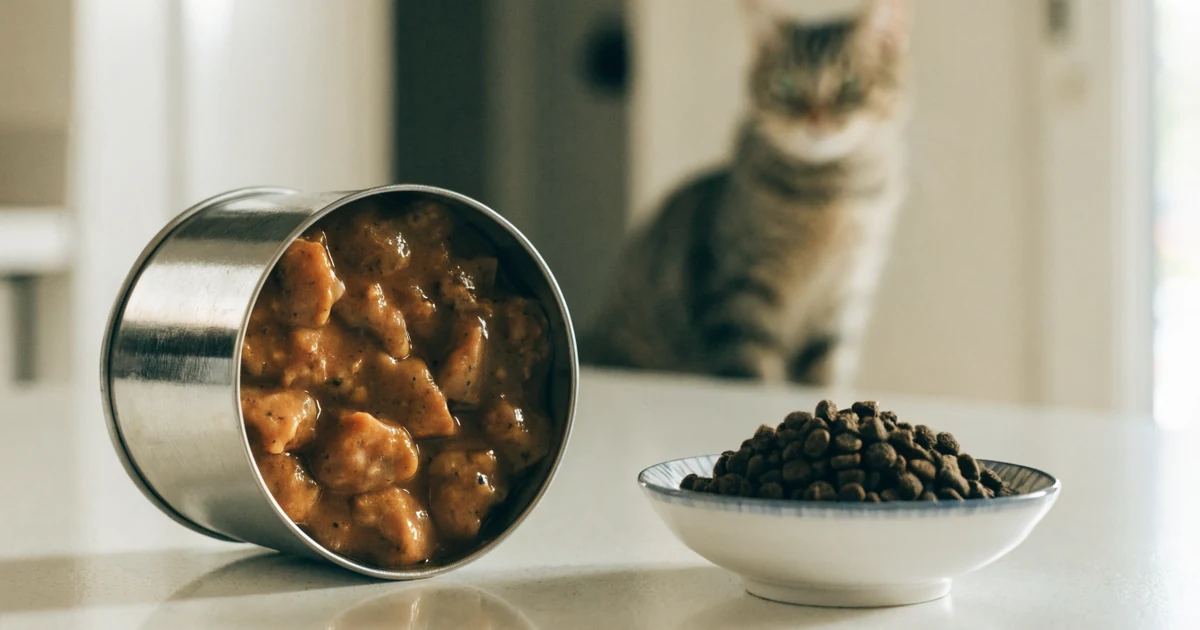
Most people who open a cat food calculator have a bowl at home that is never empty. It gets topped up when it looks low. Nobody has ever measured it, nobody knows what goes into it in a day, and the cat has been quietly setting her own portion for years.
I'm Dana Whitcomb, a certified veterinary technician. That bowl is the single most common thing standing between a cat and a healthy weight, and it isn't because anyone is careless. It's because a cat asking for food is very persuasive and a bowl gives you no information at all. So let's replace it with a number — starting with the question most of you actually came here to ask.
How much wet food to feed a cat
Answer first: divide your cat's daily calorie requirement by the calories per can printed on the label. That's the whole method, and the tool above does it — flip the segment to wet, type in the number off the can, and it hands you cans per day and cans per meal.
The reason nobody can give you a straight answer in an article is that wet food's calorie density varies more than any other pet food category. Across 790 cat diets surveyed for a 2025 study, wet foods ranged from 460 to 2,016 kcal per kilogram, median around 950. That's a more than four-fold spread. Two cans of the same size, from two brands, can be two completely different meals. Any page telling you "feed one can twice a day" without asking what's in the can is guessing.
For a benchmark you can sanity-check against: Tufts puts a medium 6 oz cat can at around 150 kcal or less for weight-management formulas. Use that to notice when a number looks wrong, not to replace reading your label.
And here's a gap I'm leaving open on purpose. We do not publish calorie figures for 3 oz or 5.5 oz cans — the two sizes most of you are actually holding. No primary veterinary source publishes them. Tufts benchmarks 6 oz and 13 oz only, and every 3 oz or 5.5 oz figure I chased traced back to a brand's own label or a blog copying one. Pâté and shreds from one brand aren't close to each other. The label lookup isn't us being lazy; it's the only honest answer that exists. If you searched how much wet food to feed cat or the fuller how much wet food to feed a cat calculator, both land in the same place: your can has the number, and this tool does the division.
Wet vs dry food for cats amounts, side by side
The maths doesn't change between them. Only the denominator does.
Dry food runs roughly 3× the calories of wet food for the same weight — about 3,606 kcal/kg against 1,198 — because canned food is mostly water. That single fact explains most feeding mistakes I see. A quarter cup of kibble and a quarter cup of pâté look like the same portion and are nothing like the same meal. So how much dry food to feed a cat is always a smaller-looking number than the wet equivalent, and that's physics rather than a judgement about which food is better.
Mixed feeding is genuinely common and barely served by any tool. The approach that works: pick one side and solve for the other. If your cat gets one 150 kcal can in the morning and her daily requirement is 234 kcal, then 84 kcal is left for kibble, and 84 divided by your bag's kcal per cup is the evening portion. Run the tool twice — once wet, once dry — and subtract. It's arithmetic, not a special mode.
The indoor cat correction every cat food calculator gets wrong
"Indoor" is not a separate factor. It doesn't exist as one anywhere in the veterinary literature I can find. AAHA, the Pet Nutrition Alliance and Merck all fold indoor and sedentary into the same row: overweight-prone / inactive = 1.0 × RER.
Now sit with what 1.0 actually means, because it's the most arresting number on this page. An inactive indoor cat's maintenance requirement equals its resting requirement. The activity surcharge rounds to zero. Everything your cat does in a day — the patrol, the window shift, the 3 a.m. sprint down the hallway — costs so little against her resting metabolism that the guidelines don't add anything for it.
That explains an enormous number of fat cats. People feed an indoor cat as though she's a small dog with a job. She isn't. She's a resting metabolism with opinions. It also explains why 1.2 is often the wrong choice for a cat who is neutered but never leaves the apartment — the inactive row fits her better, and it's 20% less food.
Cat feeding schedule: how often, and the free-feeding problem
Two meals a day is typical and works fine. More, smaller meals suit cats well — they're built to eat little and often, and there's nothing wrong with splitting the daily budget across three or four servings.
The part of a cat feeding schedule that matters isn't the number of meals. It's whether the day's food is measured. Free-feeding dry food is how most indoor cats get heavy, and the mechanism is boring: an always-available bowl means nobody knows the portion, so nobody can adjust it. You cannot correct a number you've never counted. Kittens are the reasonable exception — a growing kitten at 2.5 × RER has real demand, and Merck notes kittens may be fed free choice. An adult indoor cat at 1.0 × RER has no such margin.
How much to feed a cat chart
Find the weight, read across. The indoor column fits most cats reading this; the neutered column applies to a cat who genuinely moves around. The cans column assumes a 150 kcal can — check yours, because that's the whole point of this page.
| Body weight | RER | Indoor / inactive (×1.0) | Neutered adult (×1.2) | Cans/day (indoor) | Cans/day (neutered) |
|---|---|---|---|---|---|
| 5 lb (2.3 kg) | 129 | 129 | 155 | 0.9 | 1.0 |
| 10 lb (4.5 kg) | 218 | 218 | 261 | 1.5 | 1.7 |
| 15 lb (6.8 kg) | 295 | 295 | 354 | 2.0 | 2.4 |
| 20 lb (9.1 kg) | 366 | 366 | 439 | 2.4 | 2.9 |
| 25 lb (11.3 kg) | 433 | 433 | 519 | 2.9 | 3.5 |
Computed by Paw Charts from RER = 70 × kg^0.75 and the AAHA/PNA feline factors — paw-charts.com
Notice the curve. Doubling the cat doesn't double the food: a 10 lb cat needs 218 kcal and a 20 lb cat needs 366, not 436. That's the 0.75 exponent doing its work, and it's why the crude "25–35 kcal per pound" rule you'll see quoted around the web is wrong at both ends — it overfeeds small cats and underfeeds large ones. Metabolism doesn't scale in a straight line.
My own cat, for scale. Poppy is an 11 lb spayed indoor domestic shorthair, nine years old. Her RER is 234 kcal, and at the indoor factor of 1.0 her daily requirement is 234 kcal — the same number, which still looks like a typo every time I write it. Honest range: 117 to 351 kcal, because individual cats vary from the prediction by as much as ±50%. That's the published spread from the Pet Nutrition Alliance and Ohio State, and it's larger than any argument about whether her factor is 1.0 or 1.2 — which is what the cat calorie calculator shows you in full.
How many calories does my cat need?
Take her weight in kilograms, raise it to the power 0.75, multiply by 70. That's resting energy. Multiply by 1.0 if she's indoor or inactive, 1.2 if she's a neutered adult who moves, 1.4 if she's intact, 2.5 if she's a kitten. The cat calorie calculator does exactly this and shows the multiplier table with the places our sources disagree left visible rather than smoothed over. If what you wanted was a how much should i feed my cat calculator, that round trip is the whole of it: calories there, portions here.
Sixty-one percent, and why that number is the one to trust
As of APOP's 2022 clinical survey, 61% of US cats were overweight or obese — 28% overweight, 33% obese. That's veterinary professionals assessing body condition in the exam room, and it's the last such survey APOP has run.
You may see cheerier figures quoted from APOP's 2023, 2024 and 2025 releases. Don't use those as prevalence. They're opinion surveys — they measure what owners and vet teams think, not what anyone weighed, and APOP asks for them to be interpreted separately. Citing the 2025 figure as prevalence understates the real number badly and makes the trend look like it's improving when the clinical data says it hasn't moved in a decade.
The cat-versus-dog split is the interesting bit. Cats are less likely than dogs to be overweight-but-not-obese, and substantially more likely to be properly obese: 33% against 22%. Cats skew to the severe end. Which sets up the hardest thing on this page.
Weight loss, and the one warning that actually matters
Cats need to lose weight slowly. AAHA's target is 0.5–2% of body weight per week, and real cats come in at the bottom of it: a study of 413 client-owned cats found an achieved average of 0.8% ± 0.50 per week. Note the asymmetry against dogs, whose floor is 1% — you can see it side by side on the dog calorie calculator. Cats have a lower floor. A cat losing weight too slowly is a perfectly acceptable outcome. A cat losing weight too fast is a liver emergency, and that's not a figure of speech.
Hepatic lipidosis is the most common and potentially lethal acquired liver disease in cats, and it's why feline weight loss is supervised rather than improvised. The mechanism is losing weight too fast, or not eating at all, in a cat who is already heavy — fat mobilises faster than the liver can process it. It is not caused by weight loss itself. An overweight cat needs to lose weight; the danger is in doing it carelessly.
Merck names "forced weight loss with unacceptable food substitutions" among the triggers, and that's the exact failure mode to avoid: owner switches to a diet food, cat refuses it, cat effectively fasts, and a diet becomes a hospitalisation. The red line is 24 hours without eating — not a weight number. A cat who has eaten nothing for a day needs a vet today.
The most useful sentence on this page: a cat refusing a new diet for more than about two days warrants a call to your vet. Don't wait her out. Cats win that contest in a way that lands them on a feeding tube.
One myth to kill while we're here. You'll read that a cat must never lose more than 25% of her body weight. That figure is real but it's been turned inside out: Merck lists dramatic weight loss above 25% among the clinical signs of hepatic lipidosis that has already taken hold. It's a symptom, not a speed limit you're steering away from. Treating it as one gets the causation exactly backwards.
The tool handles this by running weight loss on ideal body weight rather than current — that's what the ideal weight field is for, and it's the detail most calculators get wrong. Feeding 0.8 × RER calculated on a cat's current, overweight body isn't a diet; it's maintenance with extra steps. Dogs and cats differ here too: the canine weight-loss factor is 1.0 at ideal weight where cats get 0.8, which the dog calorie calculator lays out if you have one of each at home.
Switching foods without causing the problem you're trying to solve
Slowly, and with a fallback. Introduce the new food alongside the old and shift the ratio over several days rather than swapping the bowl overnight. Watch that she's actually eating it — not sniffing it and walking off while you're at work. If she's eating less than usual two days running, stop and call your vet. The transition is the moment of risk, and the fix is almost always "go back to the old food and start over more slowly."
The "indoor cat" option on most cat calculators is theatre. You've seen the dropdown: indoor, low activity, moderately active, active. It looks like precision. It's decoration.
There is no indoor multiplier in any veterinary source. AAHA doesn't publish one. The Pet Nutrition Alliance doesn't. Merck doesn't. All three fold indoor cats into "overweight-prone / inactive," and that row is 1.0 × RER — meaning your indoor cat needs precisely her resting requirement and not one calorie more. A tool offering "indoor" and "low activity" as two separate choices is inventing a distinction the guidelines never made, and inventing it in the direction that feeds your cat more.
We ship one row for both, set as the default, and tell you what it means. Less impressive than a four-option dropdown. Also the actual state of the evidence, and your cat can't afford the difference.
None of this is guesswork you have to take on faith — every formula is listed with its source and the date we last checked it on how we calculate. If a number here is wrong, that's where you'll catch us. The same engine drives all our dog and cat calculators: the dog food calculator does this page's job on the other side of the house, and the cat age calculator puts nine-year-old Poppy at 52 human years, squarely in the life stage where weight starts to matter more. The dog age calculator does that job for dogs, and openly disagrees with itself about the method — which is the point of it.
Frequently Asked Questions
How much wet food should I feed my cat?
Divide her daily calorie requirement by the calories per can printed on your label — the wet mode of the calculator on this page does it for you. There's no universal answer because wet food's calorie density varies enormously: across 790 cat diets surveyed in 2025, wet foods ranged from 460 to 2,016 kcal per kilogram, a more than four-fold spread. Two same-sized cans from two brands are two different meals. As a rough benchmark, Tufts puts a medium 6 oz can at about 150 kcal or less for weight-management formulas. An 11 lb indoor cat needing 234 kcal a day would eat roughly a can and a half of a 150 kcal can. We deliberately don't publish figures for 3 oz or 5.5 oz cans — no primary veterinary source gives them.
How many calories does my cat need a day?
Less than most people expect. Take her weight in kilograms, raise it to the power 0.75 and multiply by 70 to get the resting requirement, then multiply by her factor: 1.0 if she's indoor or inactive, 1.2 for a neutered adult who moves around, 1.4 if intact, 2.5 for a kitten. A 10 lb indoor cat needs about 218 kcal a day; a 15 lb one about 295. Note that doubling the cat doesn't double the food, because metabolism doesn't scale in a straight line — which is why the common '25 to 35 kcal per pound' rule overfeeds small cats and underfeeds large ones. Individual cats vary from the prediction by as much as 50%, so treat the number as a starting point and let body condition correct it.
Do indoor cats need fewer calories?
It isn't a separate factor at all, and that's the honest answer. AAHA, the Pet Nutrition Alliance and Merck all fold indoor and sedentary cats into one row — overweight-prone or inactive — and that row is 1.0 times the resting energy requirement. What 1.0 means physically is worth pausing on: an inactive indoor cat's maintenance requirement equals her resting requirement, because the energy she spends on activity in a day rounds to zero against her resting metabolism. Calculators offering 'indoor' and 'low activity' as separate choices are inventing a distinction the veterinary guidelines don't make. If your cat is neutered and never goes out, the inactive row usually fits her better than the neutered-adult row, and it's 20% less food.
Is it dangerous for a cat to lose weight?
No — and this one matters enough to be precise about. Overweight cats need to lose weight; that's the intervention, not the risk. The danger is losing it too fast, or not eating at all, in a cat who is already heavy: fat mobilises faster than the liver can process it, which is hepatic lipidosis, the most common potentially lethal acquired liver disease in cats. Merck lists forced weight loss with unacceptable food substitutions among the triggers — the owner switches to a diet food, the cat refuses it, and the cat effectively fasts. The red line is 24 hours without eating, not any weight figure, and a cat refusing a new food for more than about two days warrants a vet call. Aim for 0.5 to 2% of body weight per week; real cats average about 0.8%.
How often should I feed my cat?
Two meals a day is typical and works well, and three or four smaller ones suit cats fine — eating little and often is normal for them. The number of meals matters far less than whether the day's food is measured. Free-feeding dry food from a bowl that's topped up whenever it looks low is how most indoor cats get heavy, and the mechanism is simply that nobody knows the portion, so nobody can adjust it. You can't correct a number you never counted. Kittens are the reasonable exception, since a growing kitten runs at 2.5 times its resting requirement and Merck notes they may be fed free choice. An adult indoor cat at 1.0 times resting has no such margin.
How many cats are overweight?
As of APOP's 2022 clinical survey — the most recent one where veterinary professionals actually assessed body condition — 61% of US cats were overweight or obese, made up of 28% overweight and 33% obese. It's worth knowing that APOP's 2023, 2024 and 2025 releases are owner and veterinary team opinion surveys rather than prevalence data, and APOP asks for them to be interpreted separately, so the friendlier numbers you may see quoted from those years don't measure the same thing. The cat-dog split is the striking part: cats are less likely than dogs to be merely overweight but substantially more likely to be obese, 33% against 22%. Cats skew to the severe end.
How much wet food should a 10 lb cat eat per day?
Start with the calorie number, because "how much wet food" has no answer until you know what is in the can. A 10 lb cat has a resting requirement of about 218 kcal a day — that is 70 multiplied by 4.54 kg to the power 0.75, the same formula your vet uses. Then apply the maintenance factor that fits: 1.0 for an indoor or inactive cat, which leaves you at about 218 kcal; 1.2 for a neutered adult, about 261 kcal; 1.4 for an intact adult, about 305. Most 10 lb pet cats land somewhere between 218 and 261. Now the division that actually answers the question: cans per day equals that figure divided by the kcal printed on your can. Tufts benchmarks a 6 oz weight-management can at around 150 kcal or less, so a neutered 10 lb cat eating cans like those needs roughly 1.7 of them a day. Swap in a richer pâté and the answer moves, which is the entire point.
Is 2 cans of wet food enough for a cat?
Cans are not a unit of energy, so this cannot be answered as asked — and that is not me dodging it. Across 790 cat diets surveyed in 2025, wet foods ranged from 460 to 2,016 kcal per kilogram, so two cans of the same size from two brands can differ more than four-fold in what they actually deliver. Do it this way instead. A neutered 10 lb cat needs roughly 261 kcal a day, so two cans are enough when each holds about 130 kcal or more, and fall short when each holds 80. The count on the counter tells you nothing; the number on the label tells you everything. If you are feeding two cans and your cat is losing or gaining weight over a few weeks, that is the real feedback loop — body condition beats any calculator, including this one.
Is 3 oz of wet food a day enough for a cat?
Almost certainly not, if that is the whole day's food. Here is the arithmetic without pretending to know your particular can. Three ounces is 85 grams. Using the density range from that same 2025 survey of 790 diets — 460 to 2,016 kcal per kilogram, median near 950 — those 85 grams carry somewhere between 39 and 171 kcal, and about 81 kcal at the median. Set that against a 10 lb cat's daily requirement of roughly 218 to 261 kcal and one 3 oz can covers about a third of it at typical density. Even at the very top of the range it does not get there. That spread is also the honest reason we do not publish a calorie figure for 3 oz cans anywhere on this site: the gap between 39 and 171 kcal is the gap between a snack and most of a meal, and only your label resolves it.
Is 1 cup of food a day enough for a cat?
A cup is a volume, so the answer depends entirely on what your bag says a cup holds — and we deliberately do not publish a grams-per-cup or kcal-per-cup figure, because kibble density varies with shape and formula and no primary veterinary source publishes a reliable one. Your bag does print kcal per cup, and that number is the only thing that converts scoops into energy. Run it against the requirement: a neutered 10 lb cat needs about 261 kcal a day, so one cup is enough if your bag states 260 kcal or more per cup, and is not if it states 180. Measuring by cup is also where most overfeeding quietly starts, because a heaped scoop and a level one are not the same meal, and a mug is not a cup. If you feed dry, weigh one scoop on a kitchen scale once to find out what you are actually serving. You only have to do it once.