
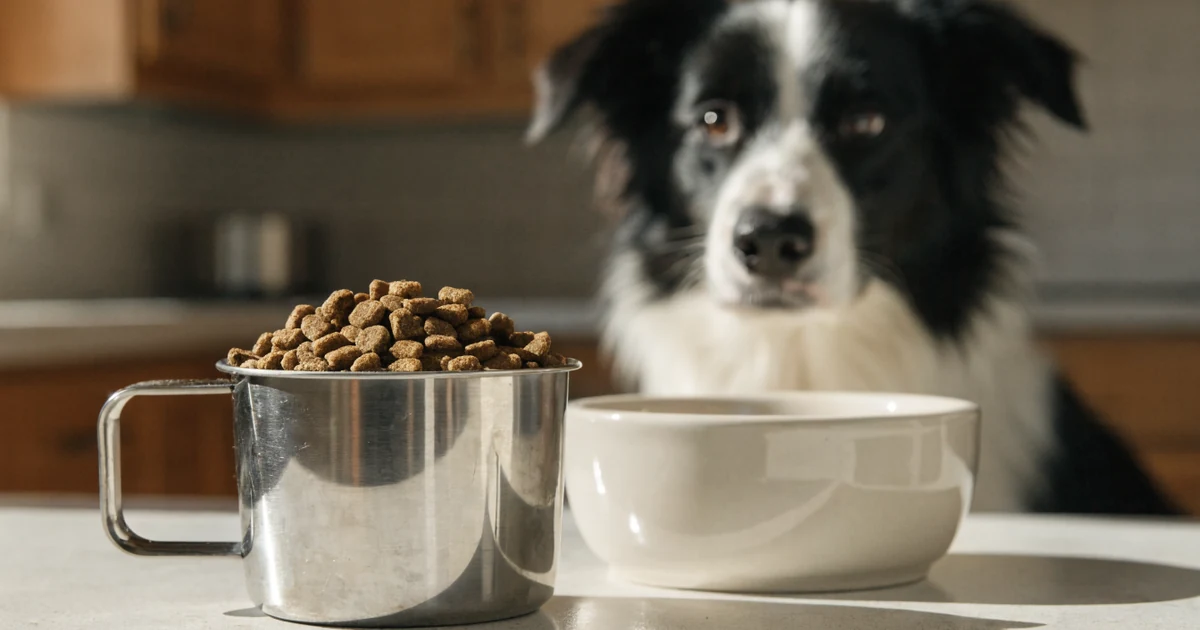
The dog food calculator above exists because of a chart on the back of your bag — weight down one side, cups down the other — and one question that chart cannot answer: where did those numbers come from?
I'm Dana Whitcomb, a certified veterinary technician, twelve years in. Owners bring me that chart constantly. They've followed it exactly and their dog is still soft over the ribs, or still standing at the bowl looking insulted. So let's start with the chart, because what I found when I went looking wasn't what I expected.
Where the numbers on your bag's feeding chart come from
Answer first: nobody standardised them. That isn't a conspiracy — it's a gap in the rules. AAFCO requires a calorie statement on every pet food label. It does not require any particular method for turning that calorie number into a feeding direction.
The 2021 AAHA nutrition and weight management guidelines put it plainly, and this one sentence is why this page exists:
In an ideal world, the pet owner will perform RER/MER calculations rather than relying solely on package guidelines because AAFCO does not standardize this process.
That's sharper than the usual complaint. The calorie number on your bag is mandatory and reliable. The cups-per-day chart beside it is unregulated in method. Two brands whose foods have identical calories per cup can print different portions for the same dog, and both are compliant. The number is regulated. The advice isn't.
The honest version of "the bag overfeeds" — which isn't what you've been told
Here I have to correct the version of this page I first meant to write. The claim circulating everywhere is that bag charts overfeed every pet. That claim is not supported.
The one directly on-point peer-reviewed study is a 2025 JAVMA paper that surveyed 790 adult cat foods against calculated energy requirements. Labels missed in both directions, and the direction depended on the size of the animal. For a 5 kg cat, 52% of high-end recommendations exceeded the equation for a lean, active cat — overfeeding. But for a 3 kg cat, 57% of low-end recommendations fell below the equation for an inactive one. Small animals were more often underfed than over.
Now the part that matters for the dog in front of you. That study is cats — only cats, only Ontario, and it read labels rather than measuring what any animal ate. There is no equivalent study of dog food labels. I looked. So I won't tell you your bag overfeeds your dog, because nobody has checked. What I can say is that the process behind that chart isn't standardised, and that alone is reason to do the arithmetic yourself.
How much should I feed my dog? The dog food calculator, step by step
Three steps, and you can do them on a phone. Take resting energy, multiply by a life-stage factor, divide by your bag's calories per cup.
Resting energy requirement — RER — is 70 × (bodyweight in kg)0.75: what a healthy dog burns doing nothing in a comfortable room. Maintenance energy, MER, is RER times a factor for what your dog actually is. Neutering isn't a footnote here. It's the difference between 1.6 and 1.8 × RER — a bigger swing than most owners expect from a fact they never think to mention.
My own dog, since I have his numbers. Wendell is 62 lb, neutered, a Labrador-hound mix of firm opinions. His RER is 855 kcal. Times 1.6 gives 1,368 kcal/day. His food runs 380 kcal per cup, so 1,368 ÷ 380 = 3.6 cups a day — 1.8 per meal on two meals. His treat allowance inside that is 137 kcal. No step of that is hidden from you, and the dog calorie calculator shows the energy side in more detail, with the places our sources disagree left visible.
Now the honest part. Individual dogs vary from these predictions by as much as ±50% — that's the Pet Nutrition Alliance and Ohio State's veterinary medical centre, and it dwarfs any argument about whether the factor should be 1.6 or 1.4. Ohio State calls its own output "zip-code level estimates." Wendell's 1,368 kcal is a starting point corrected by what his ribs feel like in a month, not a prescription.
Dog feeding chart: calories and cups per day by weight
The short answer to how much to feed a dog is the row for their weight, then a sanity check against the bag. This dog feeding chart is our engine's own output — RER, maintenance for a neutered adult, then cups at two common densities. Dry dog foods generally run around 300–400 kcal a cup, which is why both columns are here; for the calorie column on its own, the dog calorie calculator prints it.
| Body weight | RER | Neutered adult (×1.6) | Cups/day at 350 kcal | Cups/day at 400 kcal |
|---|---|---|---|---|
| 5 lb (2.3 kg) | 129 | 207 | 0.6 | 0.5 |
| 10 lb (4.5 kg) | 218 | 348 | 1.0 | 0.9 |
| 15 lb (6.8 kg) | 295 | 472 | 1.3 | 1.2 |
| 20 lb (9.1 kg) | 366 | 585 | 1.7 | 1.5 |
| 25 lb (11.3 kg) | 433 | 692 | 2.0 | 1.7 |
| 30 lb (13.6 kg) | 496 | 794 | 2.3 | 2.0 |
| 40 lb (18.1 kg) | 615 | 985 | 2.8 | 2.5 |
| 50 lb (22.7 kg) | 727 | 1164 | 3.3 | 2.9 |
| 60 lb (27.2 kg) | 834 | 1335 | 3.8 | 3.3 |
| 70 lb (31.8 kg) | 936 | 1498 | 4.3 | 3.7 |
| 80 lb (36.3 kg) | 1035 | 1656 | 4.7 | 4.1 |
| 90 lb (40.8 kg) | 1131 | 1809 | 5.2 | 4.5 |
| 100 lb (45.4 kg) | 1223 | 1958 | 5.6 | 4.9 |
Computed by Paw Charts from RER = 70 × kg^0.75 and the AAHA/PNA maintenance factors — paw-charts.com
Look across the last two columns before trusting any chart, including this one. A 50 lb dog gets 3.3 cups of one food and 2.9 of another — same dog, same day, half a cup of difference purely because the kibble is denser. That gap is what a generic "50 lb dog = 3 cups" table cannot see, and it's why the calculator asks for a number off your own bag.
How much to feed a puppy
More than you'd think, and more often. A growing dog runs at 3.0 × RER under four months and 2.0 × RER from four months to adult — roughly double an adult of the same weight, because it's paying for the growing as well as the living. Meal frequency drops on its own schedule:
| Age | Meals per day | Energy factor |
|---|---|---|
| 6–12 weeks | 4 | 3.0 × RER |
| 3–6 months | 3 | 3.0 × RER, dropping to 2.0 at 4 months |
| 6–12 months | 2 | 2.0 × RER |
| Over 12 months (adult diet) | 1 or 2 | Maintenance — 1.6 × RER if neutered |
Meal frequency from Merck's puppy care guidance; energy factors from AAHA 2021 — paw-charts.com
The bands don't line up, and I won't pretend they do — the energy factor steps down at four months, midway through the three-meals band. Nothing happens at the boundary; the puppy doesn't know it's four months old. It's a taper the guidelines draw as a step.
There's also a real disagreement between two Merck editions. The clinical edition says puppies from weaning to six months eat three times a day and never mentions a four-meal stage. The pet-owner edition gives it, and opens it at six weeks, not eight — the boundary quoted almost everywhere else, incorrectly. We follow the pet-owner schedule. Small-breed puppies may need more than three meals a day; they carry little reserve and can drop their blood sugar between meals. Large and giant breeds need a growth formula carrying an AAFCO large-breed statement, not an adult food in bigger portions.
How much to feed a puppy by weight
This is the puppy feeding chart people are really after, and it runs on your puppy's weight today, not their predicted adult weight. The exact phrase people type is puppy feeding chart by weight age, and the reason it comes out as both at once is that neither alone gets you there — weight sets the resting requirement, age sets the multiplier.
| Weight today | RER | Under 4 months (×3.0) | 4 months to adult (×2.0) |
|---|---|---|---|
| 5 lb (2.3 kg) | 129 | 387 | 258 |
| 10 lb (4.5 kg) | 218 | 654 | 436 |
| 15 lb (6.8 kg) | 295 | 885 | 590 |
| 20 lb (9.1 kg) | 366 | 1098 | 732 |
| 25 lb (11.3 kg) | 433 | 1299 | 866 |
| 30 lb (13.6 kg) | 496 | 1488 | 992 |
| 40 lb (18.1 kg) | 615 | 1845 | 1230 |
Computed by Paw Charts from RER = 70 × kg^0.75 × the AAHA 2021 growth factors — paw-charts.com
To turn any of those into cups, divide by your bag's kcal per cup — which is what the tool at the top does. Set the life stage menu to a growth option and it works as a puppy food calculator without changing pages. What separates a real puppy feeding calculator from a printed chart is that division step: a chart has to guess your food's density, and a calculator doesn't.
How much food to feed a puppy changes week to week, faster than for any adult, which is the argument for weighing rather than eyeballing. Merck tells owners to check weekly and adjust so the puppy gains a small amount each week — steady, not fast. The puppy growth chart has the curves, and the puppy weight calculator on our homepage will plot your puppy against them.
Adult portions, and the working-dog scale nobody prints
Most calculators give you one "active" checkbox. AAHA grades work into three bands, and the spread is the most striking thing in the table: light work 1.6–2.0 × RER, moderate 2.0–5.0, heavy 5.0–11.0.
That's a roughly seven-fold range inside a single word. A sled dog in harness and a weekend agility dog are both "working," and they are not the same animal to feed. If your dog does an hour of fetch on Saturday, that isn't light work — that's a neutered adult who had a nice weekend. Almost every dog reading this page is 1.6, and the dog calorie calculator shows AAHA's full graded table against Merck's point values.
There is no senior multiplier, and we won't invent one
Here we do something no competitor does, which is nothing at all. Not one of AAHA, the Pet Nutrition Alliance, Ohio State or Merck publishes a senior or geriatric energy factor. The circulating "senior dog = 1.4 × RER" figures trace to no primary guideline I could find. AAHA 2021 addresses the question and declines to answer it: canine energy requirements are thought to fall through middle age, "although results are not consistent."
So a senior number here would be one I made up. Feed an older dog as a neutered adult, or as inactive if they've genuinely slowed, and let body condition correct it — which is what the guidelines direct. One counterintuitive footnote: AAHA says senior cats may need more energy, not less, because digestibility falls with age. If that's your household too, the cat food calculator handles that side, and the dog age calculator is a better guide to when "senior" starts than a birthday is.
The treat budget, and why the 10% rule isn't about calories
Treats should be no more than 10% of daily calories — the best-sourced claim on this page; AAHA, Merck, WSAVA and Tufts all state it independently. But almost every page quoting it gives the wrong reason.
It isn't that treats are fattening. The reason is nutrient dilution. Treats and snacks carry no nutritional adequacy requirement — nobody checks that a biscuit is balanced, because a biscuit isn't meant to be. So the complete-and-balanced part has to stay above 90%, or the essential nutrients in it get diluted below what your dog needs. Go to 30% treats and you haven't just added calories; you've turned a balanced diet into an unbalanced one.
The scale lands better with Tufts' example than with a percentage. A 10 lb dog needing 300 kcal a day has a treat allowance of 30 kcal — roughly one medium biscuit. Not one per training session. One. Wendell gets 137 kcal and I still have to think about it. The allowance comes out of the daily total, not on top of it.
Dog food calculator by breed: the honest answer
Breed barely matters here, and I'd rather say so than build a dropdown that pretends otherwise. The arithmetic runs on body weight and neuter status, and those two do essentially all the work. A 62 lb Lab and a 62 lb Ridgeback of the same neuter status get the same number — the equation has no term for what shape the 62 lb is in. A dog food calculator by breed is this calculator with an extra click and a false impression of precision.
Where breed genuinely earns its place is timing and formulation. Giant breeds stay on a growth diet far longer than a terrier, because they're still growing when the terrier has been an adult a year. And breed sets the adult weight you're aiming at — a prediction question the puppy weight calculator answers from growth curves.
How much wet food to feed a dog
Flip the segment at the top to wet and it works as a how much wet food to feed a dog calculator: identical maths, different denominator. Instead of dividing by calories per cup, it divides by calories per can.
The thing to understand is density. Dry food runs around 3,606 kcal/kg and canned around 1,198 — about 3× the calories for the same weight of food, because canned is mostly water. This is why switching a dog from dry to wet by matching the volume goes so badly wrong.
Tufts puts a large 13 oz dog can at around 300 kcal or less for weight-management formulas. That's a reference point, not your can. And here's a gap I'll leave open rather than fill: we do not publish calorie figures for 3 oz or 5.5 oz cans. No primary veterinary source gives them — every figure I found traced to a brand's label or a blog copying one. The label lookup isn't laziness; it's the only honest answer available. If you feed raw instead, the raw dog food calculator handles that maths.
The measuring cup is the weakest link in this entire chain, and I just handed you one. We can argue about whether the factor is 1.6 or 1.4. Meanwhile the instrument you're using to execute the answer is a plastic scoop.
AAHA's 2014 guidelines say it directly: weigh dry food on a scale, because measuring with a cup may be imprecise — "particularly with the small amounts needed for cats and small dogs." Scoop the same kibble twice and you'll get two different weights, depending on how you dug and whether you levelled it. The labelled kcal per cup assumes an 8 fluid oz cup filled exactly level. Nobody does that. And the error is proportionally worst on small dogs, who have the least room for it.
So this calculator gives you cups, because cups are what you asked for and what your kitchen has. But grams is the honest unit, and a $12 kitchen scale will do more for your dog's waistline than any argument about multipliers. Weigh one week's portions and you've bought back the precision the cup was quietly costing you.
Every formula behind this page is listed with its source and the date we last checked it on how we calculate. If a number here is wrong, that's the page where you'll catch us.
Frequently Asked Questions
How much should I feed my dog?
Take your dog's weight in kilograms, raise it to the power 0.75, multiply by 70 — that's the resting energy requirement. Multiply that by 1.6 for a neutered adult or 1.8 for an intact one to get the daily maintenance requirement. Then divide by the calories per cup printed on your own bag. A 62 lb neutered dog has an RER of 855 kcal, a maintenance requirement of 1,368 kcal a day, and on a food running 380 kcal per cup that's 3.6 cups a day, or 1.8 cups per meal on two meals. The calculator at the top of this page does all three steps and shows the working. Treat the answer as a starting point: individual dogs vary from it by as much as 50%.
Do dog food bag charts overfeed your dog?
Not that anyone has actually checked, for dogs. The claim that bag charts overfeed everything is repeated constantly, but the only directly relevant peer-reviewed study looked at 790 cat foods, not dog foods, and found labels err in both directions — more often overfeeding large cats and more often underfeeding small ones. No equivalent study of dog food labels exists. What is documented, from the 2021 AAHA guidelines, is that AAFCO requires the calorie statement on a label but does not standardise how brands turn it into a feeding direction. So the chart on your bag is an unstandardised starting point rather than a proven overestimate. That's a good reason to do the maths yourself, and not a reason to distrust the calorie number.
How much to feed a puppy, and how often?
A puppy under four months needs about 3 times its resting energy requirement, and about 2 times from four months until it's fully grown — roughly double what an adult of the same weight would eat, because it's paying for growth as well as maintenance. A 20 lb puppy under four months needs around 1,098 kcal a day; the same puppy after four months needs around 732. Meal frequency drops as they grow: four meals a day from 6 to 12 weeks, three from 3 to 6 months, two from 6 to 12 months, then one or two as an adult. Small-breed puppies may need more than three meals a day because they can drop their blood sugar between meals. Weigh weekly and adjust so the gain is steady rather than fast.
How many treats can my dog have a day?
It sets your treat budget, and the reason isn't the one you usually hear. Treats should be at most 10% of daily calories, with the complete and balanced diet supplying the other 90% or more. The rationale is nutrient dilution, not weight gain: treats carry no nutritional adequacy requirement, so as they take up more of the diet, the balanced portion shrinks and the essential nutrients in it get diluted. Tufts' example makes the scale clear — a 10 lb dog needing 300 kcal a day has a 30 kcal treat allowance, which is about one medium biscuit. The allowance comes out of the daily total rather than being added on top of it.
Does breed change how much I should feed my dog?
Barely, and any tool suggesting otherwise is overselling. The equation runs on body weight and neuter status, and those two do almost all the work — a 62 lb Labrador and a 62 lb Ridgeback with the same neuter status get the same answer, because the maths has no term for breed. Where breed genuinely matters is life-stage timing and formulation: giant breeds stay on a growth diet much longer than small breeds, and large or giant puppies need a growth formula carrying an AAFCO large-breed statement. Breed also tells you the adult weight you're feeding toward, which is a growth-curve question rather than a feeding one.
How much wet food should I feed my dog?
Divide the daily calorie requirement by the calories per can printed on your label — the wet mode of the calculator above does exactly that. Wet food is roughly three times less calorie-dense than dry by weight, around 1,198 kcal per kg against 3,606, because canned food is mostly water, so matching portions by volume when you switch will go badly wrong. Tufts benchmarks a large 13 oz dog can at about 300 kcal or less for weight-management formulas. We deliberately don't publish calorie figures for 3 oz or 5.5 oz cans: no primary veterinary source gives them, every figure available traces to a brand label or a blog, and pâté and shreds from one brand differ substantially. Read your own can.