
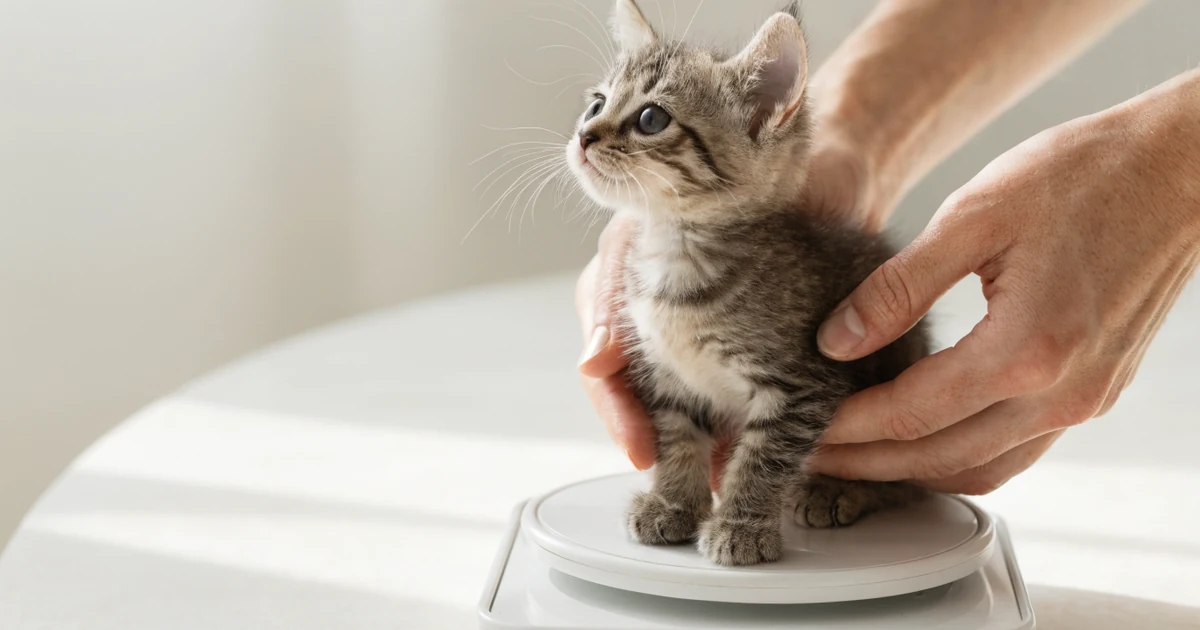
Most people arrive at a kitten growth chart holding a kitten whose birthday nobody knows. Under a deck. In a box behind a grocery store. A friend's cat had five and you took one. So there are two questions in the room, and they aren't the same question: how old is this animal, and is it growing the way it should be. The second waits on the first, which is why this page runs in that order.
I'm Dana Whitcomb, a certified veterinary technician — twelve years, seven in general practice and five on overnight emergency. Kittens of unknown age come through both doors, usually in a shoebox, usually with someone apologising for knowing nothing about them. You don't need to. The kitten tells you.
How to tell how old a kitten is
You read the body, in a fixed order, because the milestones arrive in a fixed order. This is a real shelter-medicine protocol rather than a party trick — UC Davis Koret and ASPCApro train volunteers on it — and it works because a kitten's development is far more punctual than its weight.
| What you can see | Age it points to |
|---|---|
| Umbilical cord still attached | Under 2–5 days — it falls off in that window |
| Ear canals open | 5–8 days |
| Eyes open (from the nose outward, solid dark blue) | 8–14 days per Koret; 2–16 days, typically 7–10 per International Cat Care |
| Ears fully erect | 2–3 weeks |
| Crawling | About day 18 |
| Standing | About day 21 |
| Deciduous incisors erupt | 2–4 weeks |
| Deciduous canines erupt | 4 weeks |
| Deciduous premolars erupt | 5–6 weeks |
| Adult eye colour starts to come in | 3–4 weeks — final shade a further 9–12 weeks after that |
| Permanent incisors | 12, 14 and 16 weeks per ASPCApro; 4–7 months for permanent teeth generally, per Merck |
Compiled by Paw Charts from the UC Davis Koret and UW Madison shelter-medicine guide, ASPCApro, International Cat Care and the Merck Veterinary Manual — paw-charts.com
Two rows there are arguments rather than facts, and I've left them that way. Look at the eyes. Koret says 8 to 14 days; International Cat Care says 2 to 16, commonly 7 to 10, and adds that Siamese and Oriental kittens can be born with theirs partway open. Those ranges don't fit inside each other. So I've printed the spread rather than an average that belongs to nobody.
The bottom row is worse, and it's the one that matters for an older kitten. ASPCApro puts the permanent middle incisors at 12 weeks. Merck puts permanent teeth at 4 to 7 months. Those aren't two readings of one thing — they're two months apart at the near end and they do not reconcile. Shelters use the earlier timing because it works on the floor. Both are here, attributed. I'd rather you knew the field disagrees.
Teeth take over exactly where weight gives up
Here's what makes the protocol make sense. Weight is a decent age clue early and a bad one later — and two independent sources put the cutoff in the same place. DiGangi and colleagues, in the 2019 Journal of Feline Medicine and Surgery paper this page is built on, found weight predicted age effectively through 10 weeks. ASPCApro, working from shelter practice rather than that dataset, caps its own weight-based estimate at 10 weeks too. Two roads, same wall.
So past 10 weeks you stop weighing and look in the mouth. Cats have 26 deciduous teeth and 30 permanent ones — the gap is there because kittens grow no deciduous molars at all. That's what makes the eruption sequence such a good clock: fixed events, fixed order. Unlike weight, a kitten can't be a bit small for its teeth.
"A kitten weighs a pound per month" is a good rule with a shelf life, and nobody mentions the shelf life. I've used it. Every clinic I've worked in uses it. DiGangi's team call it "the clinical guideline" and cite nobody for it — we went looking for an originating publication and couldn't find one either.
Because it was tested, and that's the part nobody reports. Run backwards the way a shelter actually uses it — weight in, age out, on kittens whose age nobody knew — the rule lands within one week of the truth 77% of the time at 6 weeks, 57% at 10 weeks, and 17.9% at 20 weeks. The phrasing you'll see everywhere is "1 lb per month, up to about six months." Six months is precisely where it has stopped working. DiGangi's own conclusion is blunter than anything I'd write: weight predicts age through 10 weeks, and past that you need something other than the scale.
One honest note on those numbers, because it caught me out. The study ran two groups: a breeding colony whose kittens had known birthdays, and privately owned kittens whose ages had to be estimated from their teeth. The rule does better on the colony — 98.8% at 2 weeks — for the obvious reason that knowing the birthday beats guessing it. The figures above are the second group, because that group is you. Quoting the colony's 98.8% next to the owned kittens' 17.9% would make the decline look twice as dramatic as it is, and the two numbers describe different cats.
The mechanism is worth a sentence. It isn't that the average kitten drifts off the rule — it tracks it fairly well the whole way. It's that the spread explodes while the rule's slope stays flat. The standard deviation at 2 weeks is 0.05 kg; at 20 weeks it's 0.40. Eight times wider, same one-pound-per-month ruler. It isn't a bad rule. It's a rule that expires, and the tool above prints its accuracy at the age you typed in rather than leaving that off the label.
The kitten growth chart: measured weight from birth to 20 weeks
Roughly a quarter pound at birth, a pound at four weeks, two and a quarter at eight, three at twelve, just under five at twenty. Here's the whole thing — and it's worth saying what it is: the only genuine numeric kitten weight table anyone has published. Birth to 6 weeks comes from a 246-cat specific-pathogen-free colony where every date of birth was actually known. The 8 to 20 week rows come from 1,310 privately owned kittens. Real animals, real scales.
| Age | Average (lb) | Average (kg) | Usual range, ±1 SD (lb) | Male (lb) | Female (lb) |
|---|---|---|---|---|---|
| Birth | 0.24 | 0.11 | 0.20–0.29 | 0.24 | 0.24 |
| 2 weeks | 0.66 | 0.30 | 0.55–0.77 | 0.66 | 0.64 |
| 4 weeks | 1.06 | 0.48 | 0.84–1.28 | 1.08 | 1.04 |
| 6 weeks | 1.46 | 0.66 | 1.19–1.72 | 1.52 | 1.39 |
| 8 weeks | 2.25 | 1.02 | 1.85–2.65 | 2.23 | 2.27 |
| 10 weeks | 2.69 | 1.22 | 2.12–3.26 | 2.80 | 2.60 |
| 12 weeks | 3.20 | 1.45 | 2.45–3.95 | 3.40 | 3.00 |
| 16 weeks | 4.25 | 1.93 | 3.24–5.27 | 4.41 | 4.01 |
| 20 weeks | 4.81 | 2.18 | 3.92–5.69 | 4.96 | 4.70 |
Source: DiGangi et al. 2019, Journal of Feline Medicine and Surgery. Kilograms are theirs; pounds are our conversion at 2.2046 — paw-charts.com
The "usual range" column is one standard deviation either side of the average — roughly the middle two-thirds of healthy kittens. It is not a pass mark. Watch it widen: a fifth of a pound at birth, nearly two pounds at sixteen weeks. Kittens don't get less normal as they grow. They get more different from each other, and the chart is honest enough to show it.
Why the kitten weight chart stops at 20 weeks
Because that's where the measurements stop. Beyond 20 weeks there is no numeric kitten weight table anywhere — not in a paper, not in a supplement, not in a chart PDF. Six months, nine months, a year: nothing published gives you a number. The centile curves below do cover that stretch, but they publish pictures instead of figures.
So the kitten growth calculator at the top of this page stops at 20 weeks and says so, rather than extending somebody else's line past its evidence and hoping you don't check. Every other kitten chart online keeps going. I don't know where they're getting it. Past 20 weeks, the record your vet builds visit by visit beats any table on the internet, including this one.
Sex differences, and the seam at eight weeks
Real, and readable from 10 weeks on. Males average 1.27 kg against 1.18 for females at 10 weeks, and 2.00 against 1.82 at 16. Before that, don't bother — a male and a female kitten of the same age are effectively the same size. That's why the tool defaults to "don't know / either" and doesn't nag you about it.
One wrinkle you should see, since it's sitting right there. At 8 weeks the females come out a hair heavier, 1.03 kg to 1.01. That's the seam: the row where the colony data ends and the owned-kitten data begins, two populations stitched together. It isn't a finding about female kittens. It's a join, and you can see it.
The most widely reproduced kitten weight chart online is the ASPCA's, and I want to be careful here: it's arithmetic, not data. Its entire eight-week table reconstructs exactly from a 100 g birth weight plus 7 to 15 g per day — we checked eight independent points and every one lands to the gram. It's a formula, published by a welfare body.
That matters for one reason. A formula can't corroborate anything. When the ASPCA chart and another chart agree, you haven't watched two sources converge — you've watched one source and its echo. And it disagrees with measurement where they overlap: its day-56 range tops out at 925 g, while the measured 8-week means sit at 920–1,020 g, at or above that ceiling. The ASPCA does enormous good and this is a chart, not a scandal. But you're owed the knowledge of which number came from weighing kittens.
When to actually worry about a kitten's weight
Direction beats magnitude, and I'd like this to be what you take away. A single weight below the average is, overwhelmingly, just a small kitten. Small kittens exist. Half of all kittens are below average — that's what average means — and most of the ones in the bottom third are going to be perfectly ordinary cats. One number, on one day, is not a diagnosis.
What earns a phone call is a kitten who stops gaining, or loses weight, or — in the first weeks — isn't gaining every single day. The shelter-medicine guide puts both halves better than I can: daily gain of any amount means the diet is meeting the kitten's needs, and lack of gain over a 24-hour period is cause for concern. That's the rule. Reassuring and actionable at once, which is rare. A kitten tracking the bottom of the range and still climbing is fine. A kitten sitting on the average who flatlines for two days is the one I want to see.
How much to feed a kitten
Three meals a day until six months, two from six months to a year, then one or two as an adult — that's the Cornell Feline Health Center's frequency guidance and it's the part that's easy. The amount is where it gets interesting, and where most advice quietly cheats.
A kitten's daily energy is usually written as 2.5 times its resting requirement. That one number is doing too much work. The Pet Nutrition Alliance gives a range of 2 to 3, decreasing from about four months — so a flat 2.5 underfeeds an eight-week-old and overfeeds a nine-month-old, wrong in opposite directions at the two ends of kittenhood. The AAHA/AAFP feline life stage guidelines size the change exactly: about 200 kcal per kg of bodyweight per day at 10 weeks, about 80 at 10 months. No fixed multiplier survives that.
Arithmetic: a 5 lb kitten — roughly the top of the table above — has a resting requirement of about 129 kcal a day. Times 2.5, that's 322. Across the honest 2-to-3 range it's 258 to 387, and that spread is the truth rather than a hedge. For the portions themselves, from the calorie number on your own bag, use the cat food calculator — that's where the label maths lives and I won't rebuild it here. The cat calorie calculator shows the equation underneath.
How much wet food to feed a kitten
The shelter-medicine answer for a seven-to-eight-week-old is about one 3 oz can a day per kitten, split across two or three meals. That's a starting point from people who raise a lot of kittens, not a prescription — cans differ enormously in calories, which is exactly why a "how many cans" answer can't be right in general.
Run your own tin's kcal figure through the cat food calculator and you'll get a number that belongs to your kitten and your food. One line from the shelter guide I love, because it cuts against every anxious instinct: you cannot overfeed a kitten, but you can feed a kitten too often. A full kitten is pear-shaped held up under the front legs. That's the check.
How big will my kitten get?
Somewhere around 9 pounds, probably — and I want to be careful where that comes from. The largest real dataset on adult cat weight, 136,052 cats in UK veterinary records, puts the median at 4.16 kg, about 9.2 lb, with the middle half between 3.30 and 4.99 kg (7.3 to 11.0 lb). That describes the cat population as it actually is, overweight cats included. It is not a target.
Which brings me to the number you'll see everywhere else. "A typical adult cat is 8 to 10 lb" is a convention. No veterinary body publishes a normal adult cat weight range — I went looking. Cornell deliberately declines: it defines obesity relative to the individual cat's own normal and sends you to body condition score instead of a scale reading. That's not a dodge. It's a better method. A 12 lb cat with a visible waist and ribs you can feel isn't a problem. A 9 lb cat with neither might be.
Breed does move the needle, honestly measured: Maine Coons really do end up about 20% heavier than mixed-breed cats. The famous "Maine Coons take three to five years to reach full size" line has no veterinary source I could find — it's breeder lore, repeated until it sounded researched. Nobody has published a Maine Coon growth curve at all. Once he's grown, the cat age calculator is the more useful page.
Neutering, and the claim that fails the one study built to test it
Neutering does change a cat's skeleton, and here the cat literature is better than the dog literature — not something I get to say often. Root and colleagues, in 1997, gonadectomized kittens at 7 weeks or at 7 months and compared them against intact controls on serial radiographs. Neutering delayed growth-plate closure and significantly increased final radial length. Bone, not bodyweight. A real, measured effect.
Then the part everyone drops. In the authors' own words: "Age at gonadectomy had no effect on age and radial length at time of the growth plateau." Neutered at 7 weeks or at 7 months — identical outcome. So every "don't neuter early or he'll grow too tall" claim fails the one study designed to test exactly that. What matters is whether, not when.
Weight after neutering is a separate mechanism and shouldn't be bolted onto this one. Neutering raises obesity risk, especially in males, per the AAHA/AAFP guidelines. That's energy in and energy out, manageable with the food bowl, and nothing to do with growth plates. Two conversations that keep getting held as one.
There is a real kitten growth curve. It has three holes in it.
Yes — and here cats and dogs genuinely part company, so the contrast is worth drawing. Salt and colleagues published feline growth standards in PLOS ONE in 2022: same institute, same Banfield data, same GAMLSS/BCCG modelling as the 2017 dog paper, 8 to 78 weeks, nine centiles, males and females modelled separately. Good work, and it exists. Over on the puppy growth chart the problem is the opposite one: for giant breeds there is no curve at all, because growth over 88 lb was too inconsistent to model. Dogs have a missing standard. Cats have a standard with holes.
Hole one is the defect the dog paper shares: graphs only, no numeric table. We checked three ways, including pulling the text layer out of the Royal Canin chart PDFs the AAFP hosts — axis labels and nine percentile labels, not one weight value anywhere. Hole two: it starts at 8 weeks, so the whole window where "how old is this kitten" gets asked sits outside it.
Hole three is the big one, and it's why we lean on the measured table instead of digitizing those curves. The standard is not validated for neutered cats. The authors excluded them by design — intact only — and say themselves that further work is needed before the standards can be applied to neutered kittens. Most pet cats are neutered by four to six months. So a growth standard running to 78 weeks formally applies to a minority of the animals it would be used on. That isn't a criticism of the paper; the authors flagged it. It's a criticism of everyone who cites the chart without mentioning it.
What those charts do say, in their own words, is the best advice in the subject: there is no ideal percentile line, and growth is normal provided it tracks along the same line over time. Not the middle line. The same line. Which is the "watch the direction, not the number" rule from further up this page, arrived at from a completely different direction.
Every figure here is listed with its source and the date we last checked it on how we calculate — including the ones we decided not to publish, and why. For the same question on the other species, the dog age calculator shows how differently a life front-loads, and the cat age calculator picks this kitten up at the year mark. The rest of the dog and cat calculators run on the same engine and the same data file; if a number here is wrong, that page is where you'll catch us.
Frequently Asked Questions
When do kittens stop growing?
Honestly, further out than most pages admit, and the evidence thins as you go. The only measured kitten weight table runs to 20 weeks, where the average kitten is about 4.8 lb (2.18 kg) — past that, no numeric table exists anywhere. The published feline centile curves do run to 78 weeks, but they print graphs rather than numbers, so nobody can look a value up. What we can say is that most cats are near adult size somewhere around 10 to 12 months, with real breed variation on either side, and that skeletal maturity in cats completes later than that. Anyone giving you a precise week is extrapolating. We stop at 20 weeks because that is where the measurements stop.
How can you tell how old a kitten is?
You read the body rather than the scale, in the order the milestones arrive. The umbilical cord falls off at 2 to 5 days. Ear canals open at 5 to 8 days. Eyes open somewhere between 8 and 14 days, though sources disagree and International Cat Care gives 2 to 16 days, typically 7 to 10. Ears stand up at 2 to 3 weeks, crawling starts around day 18 and standing around day 21. Then the teeth take over: deciduous incisors at 2 to 4 weeks, canines at 4, premolars at 5 to 6. Weight works as an age clue only through about 10 weeks — DiGangi's study and ASPCApro reached that same ceiling independently. After 10 weeks, look in the mouth.
Is my kitten too small?
Probably not. A single weight below the average is usually just a small kitten — half of all kittens are below average, that is what average means, and the measured spread is wide. At 12 weeks the middle two-thirds of healthy kittens fall anywhere between 2.45 and 3.95 lb, which is a range of over a pound and a half. What matters is direction, not position. The shelter-medicine rule is the clearest one going: daily weight gain of any amount means the diet is working, and no weight gain over a 24-hour period is a reason to call someone. A kitten tracking along the bottom of the range and still climbing is usually fine. A kitten who stops gaining, or loses weight, is not.
How big will my kitten get?
Around 9 lb, most likely, but the honest version needs a caveat. The largest real dataset — 136,052 cats in UK veterinary records — puts the median adult cat at 4.16 kg, about 9.2 lb, with the middle half between 7.3 and 11.0 lb. That describes cats as they are, overweight ones included, so it is not an ideal to aim at. The familiar 8 to 10 lb figure is a convention with no veterinary body behind it: Cornell deliberately avoids publishing a normal range and defines obesity relative to each cat's own normal, using body condition score instead. Maine Coons genuinely end up about 20% heavier than mixed-breed cats, but the claim that they need three to five years to get there has no veterinary source at all.
How much should I feed a kitten?
Three meals a day until six months, twice daily from six months to a year, then once or twice as an adult — that is Cornell's guidance. The amount is harder than the schedule. Kitten energy is usually quoted as 2.5 times the resting requirement, but the Pet Nutrition Alliance gives a range of 2 to 3 that decreases from about four months, so one flat multiplier underfeeds a young kitten and overfeeds an older one. The AAHA/AAFP guidelines size the change exactly: about 200 kcal per kg per day at 10 weeks, about 80 at 10 months. For actual portions from your own food's calorie number, use our cat food calculator rather than the chart on the back of the bag.
Does the pound-per-month kitten rule actually work?
It works, and then it stops working, and the second half never gets mentioned. The rule is a convention — DiGangi's team call it the clinical guideline and cite no originator, and we could not find a veterinary publication that proposes it. But it was tested. Used the way a shelter uses it, weight in and age out, on kittens whose age nobody knew, it lands within one week of the truth 77% of the time at 6 weeks, 57% at 10 weeks, and just 17.9% at 20 weeks. The usual phrasing, 1 lb per month up to about six months, is precisely the range where it fails. The paper's own conclusion is that body weight predicts age well through 10 weeks and that you need other evidence beyond that, which is why ASPCApro caps weight-based aging at 10 weeks too. The reason is the spread: the standard deviation grows from 0.05 kg at 2 weeks to 0.40 kg at 20, while the rule's slope never changes.