
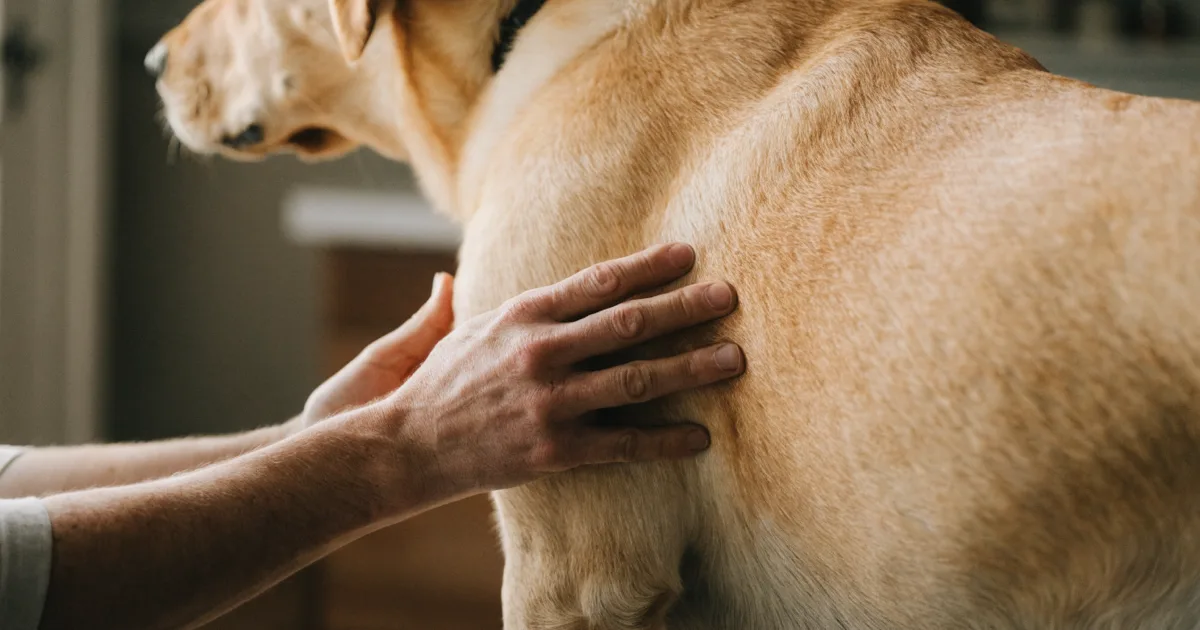
I weigh dogs all day. The number on the scale is the least useful thing I learn about them.
I'm Dana Whitcomb, a certified veterinary technician, twelve years between general practice and emergency. A 28 kg labrador can be lean, ideal, or genuinely obese, and the scale reports 28 kg for all three. What separates them is what my hands find over the ribs, and that is what a body condition score is: a structured way of turning touch into a number that another person can repeat.
What is a good body condition score for a dog?
Four to five out of nine. WSAVA's chart sorts the nine scores into three bands and puts only 4 and 5 in the ideal band. Scores 1 to 3 are under ideal; scores 6 to 9 are over ideal. There is no fourth band and no "acceptable" zone either side — a 6 is not a slightly generous 5, it is the first score on the over-ideal side of the chart.
Worth knowing if you also have a cat: the ideal band is not the same for both species. WSAVA labels only 5 of 9 as ideal for cats, with 4 sitting under ideal. The tidy "4 to 5 for everyone" line you see repeated is wrong for cats, and we cover that on the cat calorie calculator.
How to body condition score a dog in three checks
Do it with the dog standing, and do it with your hands before your eyes. Coat length defeats vision, not touch.
Ribs. Run your fingertips flat across the ribcage, the way you would read a page rather than prod it. At an ideal score the ribs are easy to feel with only a thin covering over them. If you have to press to find them, that is fat between your fingers and the bone. If you can see them clearly from across the room, you are on the under-ideal side.
Waist, from above. Stand over your dog and look down. There should be a visible narrowing behind the ribcage — the chart's phrase is that the waist is "observed behind ribs when viewed from above." Straight sides mean no waist. Sides that bulge outward past the ribs mean an 8 or a 9.
Abdominal tuck, from the side. Crouch to the dog's level. The belly should slope upward from the bottom of the ribcage toward the hind legs. A belly that runs level with the ribcage, or hangs below it, is the tuck disappearing.
Two of three is not a score. If the ribs say 4 and the waist says 6, that is usually a coat problem or a hands problem, and it is worth having a vet or nurse score the dog alongside you once so you calibrate. Body condition scoring is repeatable between people who have been shown it, and guesswork for people who have not.
One group this does not settle: growing puppies. A puppy who is lean because they are mid-growth-spurt and a puppy who is genuinely underfed can score the same on a chart built for adults, and the useful question there is whether they are tracking their expected curve rather than what their ribs feel like this week. That is a different tool — the puppy weight calculator plots a puppy against real breed-size growth curves. Score body condition alongside it, not instead of it.
Why you keep meeting two different scales: 5/9 and 3/5
Because two scales are in circulation, and the number is meaningless without its denominator. The 9-point scale used above is the one WSAVA publishes and the one most nutrition research uses. A 5-point scale also exists, and on that one the middle score — 3 out of 5 — is the ideal.
So a dog written up as 3/5 and a dog written up as 5/9 are being described as the same thing: right in the middle, right where they should be. A dog written up as "3" with no denominator could be either ideal or distinctly thin, which is exactly why your vet's notes should say which chart they used. If you are reading a record and cannot tell, ask before you change anything about feeding.
One honest caution: I am describing the two scales as both placing ideal at their own midpoint, which is how they are built. There is no official WSAVA crosswalk table converting 5-point scores to 9-point scores, so treat any precise-looking conversion chart you find elsewhere with suspicion.
The "each point is 10% over ideal weight" rule that WSAVA never printed
You will find this everywhere: every body condition score above 5 means your dog is roughly 10% over their ideal weight, so a 7 is 20% over. It is a tidy rule. It lets a page convert a score straight into a target weight, which is what everybody wants.
I went to the WSAVA dog chart to source it properly, and it is not there. The chart carries the nine descriptions, the three bands, and four literature references. It states no percentage of body fat and no percentage over or under ideal body weight for any score. Not one number of that kind appears on it.
What does exist is the validation study the chart is built on — Laflamme's 1997 work developing and validating the 9-point system against dual-energy x-ray absorptiometry, which is the reference method for measuring body composition. The relationship that study established is that each point on the scale corresponds to roughly a 5% difference in body fat. Note what that is a percentage of: body fat, not body weight. Those are two different quantities, and the popular rule has quietly swapped one for the other and doubled it along the way.
This matters practically, because a weight-loss plan built on a made-up target weight is a made-up plan. If you need an ideal weight to feed to — and our dog calorie calculator does ask for one when you choose weight loss — get that number from your vet, who can set it from the dog's frame, breed and history rather than from arithmetic on a score. That is a slower answer than a conversion table. It is also the only one I can source.
Body condition is not muscle condition
A dog can sit squarely at 5 out of 9 and still be losing muscle. Body condition score measures fat. Muscle mass is assessed separately, by feeling over the skull, shoulder blades, spine and pelvis for the muscle covering those bones, and WSAVA publishes a muscle condition chart of its own for the purpose.
I am not going to print the muscle scoring categories here, because the numbering differs between the systems in use and a bare "3" would be as ambiguous as the 3/5 problem above — which is precisely why the question comes up. What is worth carrying away is the concept: fat and muscle are scored on different charts, they move independently, and muscle loss in an older dog with a perfectly respectable body condition score is a real finding rather than a contradiction. Raise it with your vet as its own question.
Age is the reason this comes up so often, and "older" is doing a lot of work in that sentence — a seven-year-old great dane and a seven-year-old terrier are not at the same life stage. Our dog age calculator is size-adjusted for exactly that reason, and it is worth knowing roughly where your dog sits before deciding whether a change in condition is ageing or something to investigate.
What to actually do with the number
If your dog is 4 or 5, do nothing except keep scoring them every few weeks. The value of body condition scoring is the trend, not the reading. Fat accumulates too slowly to notice by eye on an animal you see every day, which is the entire reason the method exists.
If your dog is 6 or above, the next question is calories, and it is worth being unsentimental about the arithmetic — most overfeeding is treats and table food rather than the measured meal. Our dog food calculator converts a daily requirement into portions from your own bag, and the dog calorie calculator shows the energy maths underneath it. Both are better used with a vet-set target weight than a guessed one.
If your dog is 3 or below, that is a veterinary appointment rather than a feeding adjustment. Weight loss in dogs is a symptom far more often than it is a diet, and the under-ideal descriptions at 1 and 2 both mention loss of muscle mass, which points away from simple underfeeding.
Frequently Asked Questions
What is a good body condition score for a dog?
Four to five out of nine. WSAVA's chart divides the nine scores into three bands — under ideal, ideal and over ideal — and places only 4 and 5 in the ideal band. At a 5 the ribs are palpable without excess fat covering, the waist is visible behind the ribs when you look down from above, and the abdomen tucks up when viewed from the side. A 4 is the leaner end of the same band: ribs easily palpable with minimal fat covering. There is no buffer zone on either side, so a 6 is not a generous 5 — it is the first score on the over-ideal half of the chart. One species caveat worth carrying: WSAVA labels only 5 of 9 as ideal for cats, so the familiar "4 to 5" shorthand does not transfer across.
What does a 5/9 body condition score mean for a dog?
It means your dog is in the middle of the scale, in the ideal band, and that whoever scored them was using the 9-point WSAVA chart. In the chart's own wording, a 5 has ribs palpable without excess fat covering, a waist observed behind the ribs when viewed from above, and an abdomen tucked up when viewed from the side. Practically, that is a dog you should change nothing about, beyond re-scoring every few weeks to catch drift early. The reason the denominator matters so much here is that a plain "5" written without it could just as easily come from a 5-point chart, where 5 out of 5 is the most overweight score on the scale rather than the ideal one. If you are reading a record and it says 5 with no denominator, ask which chart it came from before you act on it.
What does a 1/5 body condition score mean for a dog?
That is the bottom of the 5-point scale, and it means severely underweight — the opposite of what the same digit means on the 9-point chart. This is the single most common confusion in body condition scoring, and it is worth slowing down for. On the 5-point scale, 3 out of 5 is the ideal midpoint and 1 out of 5 is emaciated. On the 9-point scale, ideal sits at 4 to 5 and 1 out of 9 is emaciated. So a "1" is a serious finding on both, but a "3" is ideal on one chart and thin on the other. Always read the denominator. A dog scored at the bottom of either scale needs a vet rather than a bigger dinner, because the emaciated descriptions on both charts include loss of muscle mass, which usually points to an underlying problem rather than simple underfeeding.
Is a muscle condition score of 3 for a dog good?
It depends entirely on which muscle chart produced it, and that ambiguity is the honest answer rather than a dodge. Muscle condition is scored separately from body condition, on its own chart, by feeling for the muscle covering the skull, shoulder blades, spine and pelvis. The numbering is not standardised across the systems in circulation the way the 9-point body condition scale is, so a bare "3" can mean normal muscle mass in one scheme and marked loss in another. Ask whoever recorded it which chart they used and what the top of that scale represents. The more useful thing to take away is that muscle and fat are assessed independently: a dog can hold a perfectly respectable body condition score of 5 while losing muscle, and in an older dog that combination is a real finding worth raising with your vet in its own right.
How do I work out my dog's ideal weight from their body condition score?
Not from the score alone, and I would be careful with any page that offers to. The rule you will see everywhere is that each point above 5 equals about 10% over ideal body weight, so a 7 means 20% over. That rule is not printed on the WSAVA chart — the chart carries the nine descriptions, the three bands and its references, and no percentage of body fat or body weight anywhere on it. What the underlying validation work by Laflamme in 1997 established, measuring against dual-energy x-ray absorptiometry, is that each point corresponds to roughly a 5% difference in body fat. Body fat is not body weight, and the popular shortcut has substituted one for the other and doubled it. Get a target weight from your vet, who can set it against your dog's frame, breed and weight history. Our calculators ask for an ideal weight precisely because we will not manufacture one for you.
Can you body condition score a fluffy dog?
Yes, and touch is exactly why the method is built around your hands rather than your eyes. On a long-coated or double-coated dog the waist and the abdominal tuck can be invisible from across the room while being perfectly easy to feel. Run your fingertips flat over the ribcage rather than poking at it, then feel for the narrowing behind the ribs and for the upward slope of the belly toward the hind legs. Wet coats and post-groom coats will make the same dog look like two different animals in photographs while the score has not moved at all, which is a good reminder that photo-based assessments — including strangers scoring your dog from a picture online — are the least reliable version of this. If the coat is defeating you, ask your vet or a veterinary nurse to score the dog alongside you once so that you learn what an ideal ribcage feels like on your particular dog.